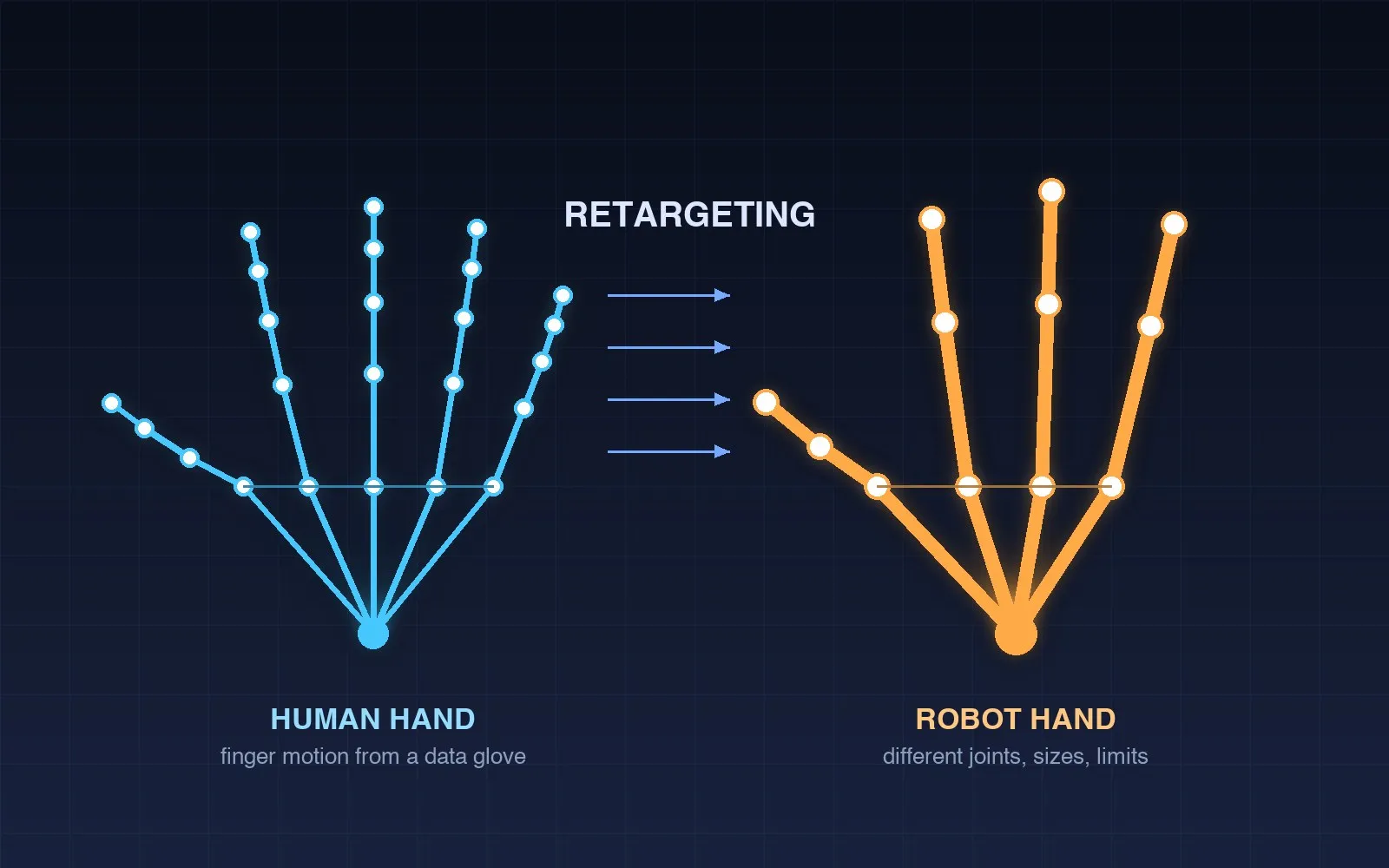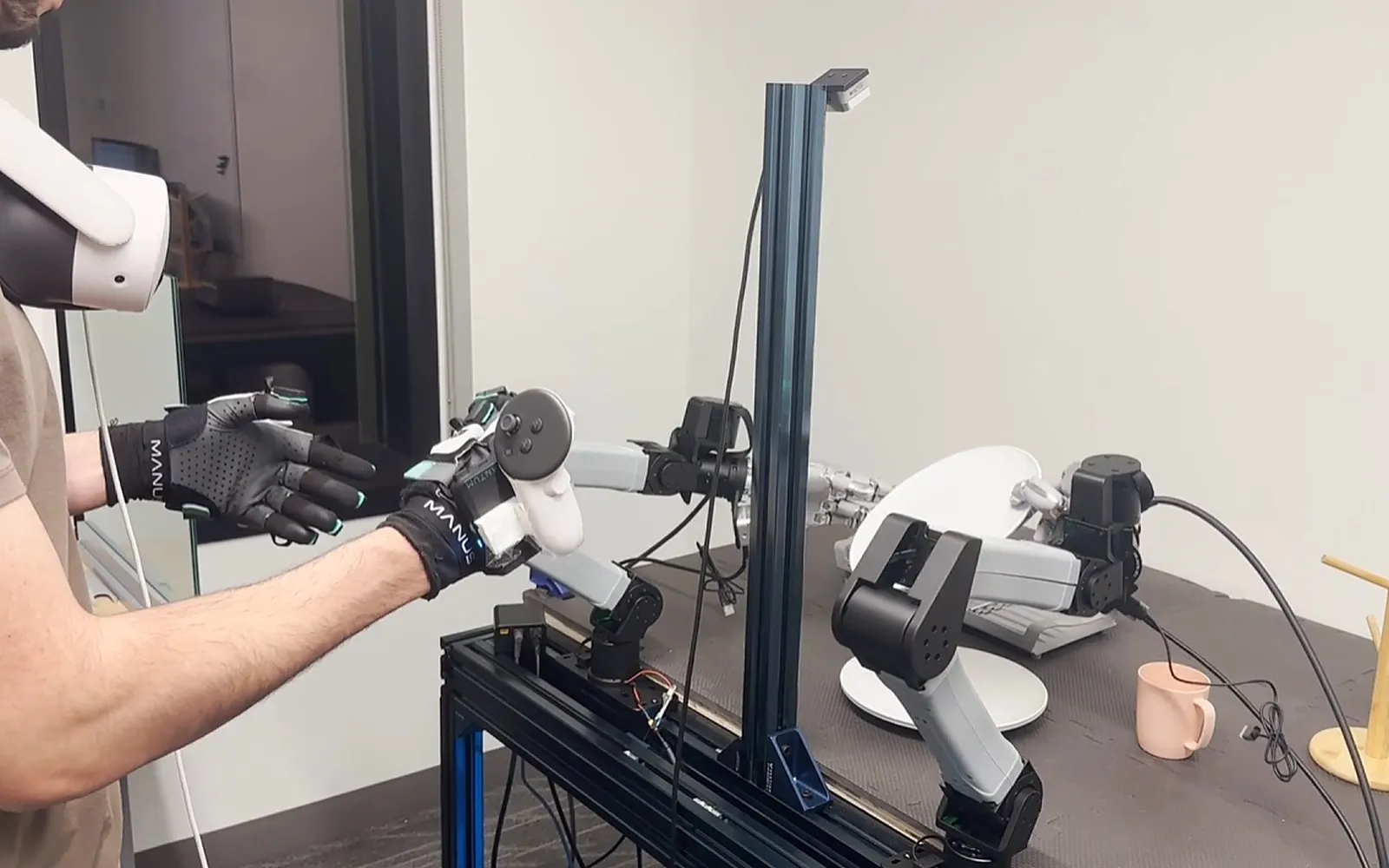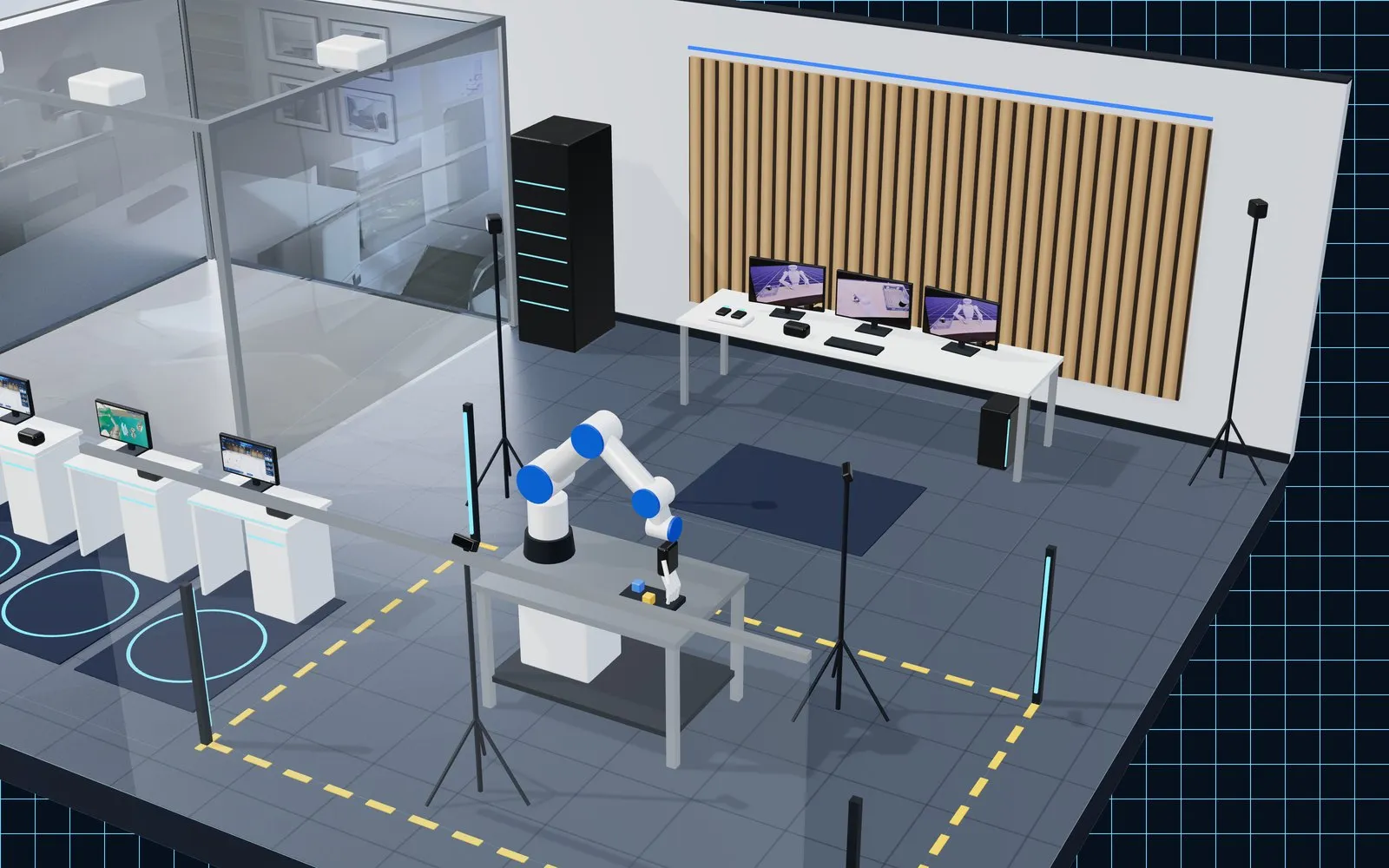
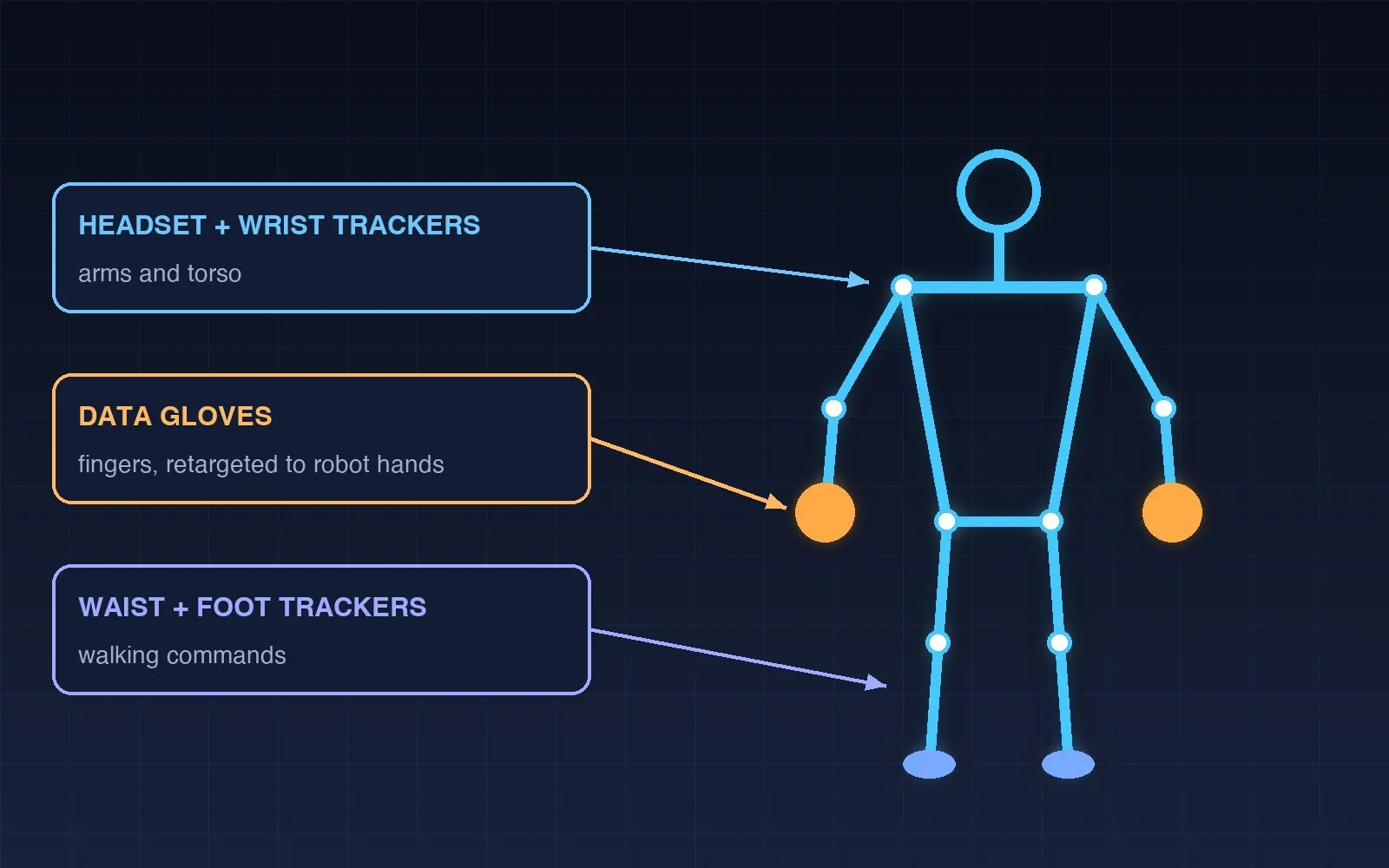
In short: a data glove is one stream in a larger system, not the whole system. In a humanoid, the glove handles the fingers only, while headset and wrist trackers handle the arms, extra trackers handle walking, and a retargeting layer turns finger motion into commands for the robot hand. Two published MANUS use cases show this clearly: the USC Physical Superintelligence (PSI) Lab's rig behind the Psi-0 humanoid foundation model, and ROBOTERA's ROS 2 pipeline for its XHAND1 robot hand. Both are useful blueprints for a Physical AI lab.
Our earlier guides explain how MANUS gloves train robot hands and how glove motion is retargeted onto robot hands. This article looks at the next question: what does the full system around the glove look like?
Case 1: USC PSI Lab and the Psi-0 humanoid model
The USC PSI Lab built a teleoperation system that lets one operator control a humanoid's whole body. It supports Psi-0, an open foundation model for humanoid loco-manipulation, meaning tasks that combine walking with handling objects. The paper (arXiv 2603.12263, March 2026) appears in the proceedings of Robotics: Science and Systems 2026.
MANUS describes the rig in a use case published on 31 March 2026. The control is split into three streams:
- Upper body: a PICO headset and two wrist trackers capture arm and torso pose. An inverse kinematics solver that tracks several targets at once turns that into joint commands.
- Hands: MANUS gloves capture the finger motion. It is retargeted to the Dex3-1 hands, which have three fingers, on a Unitree G1 humanoid. MANUS says the lab paired gloves with wrist trackers so that fingers hidden from a camera do not break hand control, which is a known weakness of vision-based VR hand tracking.
- Walking: waist and foot trackers send locomotion commands to a reinforcement-learning lower-body controller.
### How the data was used
The paper reports a staged recipe rather than one large training run:
- A vision-language backbone is pre-trained on about 829 hours of human egocentric video.
- An action expert is post-trained on roughly 30 hours of real humanoid data.
- For each task, the model is then adapted with 80 teleoperated demonstrations. This is the step where clean finger and arm data matters most.
On eight long-horizon real-world tasks, the authors report that Psi-0 beat the second-best baseline, GR00T N1.6, by over 40% in average success rate, and outperformed baselines that used over ten times as much pre-training data. These are the authors' figures from their own setup. The paper credits the staged training approach and the quality of the data. The glove is one part of that data pipeline, so the result should not be read as an effect of the glove alone.
Case 2: ROBOTERA and the XHAND1 robot hand
ROBOTERA makes XHAND1, a human-sized dexterous hand with 12 actuated degrees of freedom. In a use case dated 4 September 2025, MANUS describes how ROBOTERA connected gloves to the hand through ROS 2. The challenge is speed and precision: vision-based tracking adds latency and loses fingers when they overlap or leave the camera's view.
The pipeline has three parts:
- MANUS ROS 2 package. A software layer built on the MANUS C++ SDK. According to the documentation, it publishes one ROS 2 topic per connected glove, carrying the glove ID, side, raw skeleton nodes and ergonomics values, plus raw sensor data on the Metagloves Pro series. Ergonomics data publishes at 120 Hz by default.
- A retargeting layer. It translates glove input into the hand's 12-degree-of-freedom motion for fine manipulation.
- XHandControlROS2. A package that talks to the hand over EtherCAT and exposes joint control and sensor readout through topics, services and callbacks.
MANUS and ROBOTERA describe a trial called the "Pressure-to-Haptic Bridge", which would connect the hand's tactile sensors to future haptic gloves. The stated goals are real-time feedback of force, texture and temperature to the operator, and datasets that pair hand motion with touch. This is a plan, not a released result.
What the two cases have in common
- The glove covers the fingers only. Wrist, arm and body pose come from other trackers.
- A retargeting layer sits between glove and robot. Both cases need a mapping from human fingers to a robot hand with different joints.
- Standard middleware connects the parts. ROS 2 topics make the glove stream available to the rest of the robot stack.
- Data quality is the goal. Both describe the glove as a way to record cleaner demonstrations, not as the source of the learning gains.
Both sources are use cases published by MANUS, so they describe the vendor's own products. The Psi-0 results come from the peer-reviewed paper, but the glove-specific details come from the vendor's page.
What a lab can take from this
These are practical suggestions based on the two cases, not claims from them.
- Plan the system, not just the glove. Budget for wrist trackers, a headset, and a robot hand with a known model.
- Keep each stream separate and time-stamped. Fingers, arms and locomotion should be recorded on one clock so episodes can be replayed.
- Use ROS 2 as the common layer so the glove, the retargeter and the robot hand can be swapped independently.
- Fix the number of demonstrations per task early. The Psi-0 recipe uses 80 per task, so recording capacity and operator training time decide the schedule.
- Treat touch as the next upgrade. Keep the data format ready for contact signals.
Where Aedu AI fits
Aedu AI designs, supplies and installs Physical AI Labs and XR Labs in Singapore, Malaysia and across Southeast Asia. We supply MANUS Metagloves, set up NVIDIA Isaac Teleop and Isaac Lab, connect your robot through ROS 2, and train your team to record clean data. For a university lab that combines VR and physical practice, see Train in VR, Learn in the Real Room. To plan a lab, get in touch.
Key points
- A glove handles fingers; arms, torso and walking need other trackers.
- USC PSI Lab's rig combines a PICO headset, wrist trackers, MANUS gloves and foot trackers on a Unitree G1 with Dex3-1 hands.
- Psi-0 is adapted to each task with 80 teleoperated demonstrations, and the authors report a gain of over 40% over the second-best baseline.
- ROBOTERA connects MANUS gloves to its 12-degree-of-freedom XHAND1 hand through ROS 2 and a retargeting layer.
- Both are vendor-published use cases, and the results are the authors' own.
FAQ
Can MANUS gloves control a whole humanoid?
Not on their own. In the USC PSI Lab rig, the gloves control the fingers, a headset and wrist trackers control the arms and torso, and foot trackers command walking.
Which humanoid and hands did USC PSI Lab use?
A Unitree G1 humanoid with a Dex3-1 three-finger hand on each arm. MANUS says thumb, index and middle finger motion is retargeted to those hands.
How does a MANUS glove connect to ROS 2?
Through the MANUS ROS 2 package, which publishes one topic per glove with skeleton, ergonomics and, on the Metagloves Pro series, raw sensor data. A retargeting node then maps this to your robot hand.
Does this prove gloves make humanoids learn better?
No. The Psi-0 authors credit staged training and data quality. The glove is part of the data collection, and the paper does not isolate its effect.
How many demonstrations does a task need?
It depends on the model and the task. The Psi-0 recipe uses 80 teleoperated demonstrations per task for fine-tuning after pre-training on much larger datasets.
Can Aedu AI set up a similar system?
Yes. We design Physical AI Labs with MANUS gloves, Isaac Teleop, Isaac Lab and ROS 2. See our Physical AI Lab page.
Sources
- Psi-0: An Open Foundation Model Towards Universal Humanoid Loco-Manipulation (arXiv, 12 March 2026): https://arxiv.org/abs/2603.12263
- Same paper in Robotics: Science and Systems XXII (2026): https://roboticsproceedings.org/rss22/p021.html
- MANUS use case, USC PSI Lab humanoid foundation model (31 March 2026): https://www.manus-meta.com/use-cases/how-manus-gloves-enable-dexterous-teleoperation-for-usc-psi-labs-humanoid-foundation-model
- MANUS use case, ROBOTERA (4 September 2025): https://www.manus-meta.com/use-cases/robotera-advancing-dexterous-robotics
- MANUS documentation, ROS 2 package: https://docs.manus-meta.com/3.0.0/Plugins/SDK/ROS2/ros2%20package/
The cover image is an Aedu AI illustration. The MANUS pages are vendor-published use cases.
- MANUS
- Humanoid Robot
- Case Study
- ROS 2
- Teleoperation