"Robot gym" is becoming a common phrase in physical AI. The idea is simple: instead of collecting robot training data wherever it happens to be convenient, you build a place whose whole job is producing it. On 22 October, NEURA Robotics and the Technical University of Munich (TUM) opened a large example.
What opened in Munich
The TUM RoboGym is a training centre covering over 2,300 square metres at LabCampus, close to Munich's airport. NEURA and the university created it together, working with TUM's MIRMI robotics institute. The announcement says the partnership is set for three years at first, with about EUR 17 million invested in total and roughly EUR 11 million of that coming from NEURA.
Industry partners have been working through their own workflows there since September 2026. They come from more than ten industries, from carmaking and pharma to logistics, farming and care. The example tasks are down-to-earth ones: moving cardboard boxes, filling bottles and handling wooden parts.
NEURA describes the Munich site as the first location of an international NEURA Gym network, with more planned in Europe, the US and China, and another German gym under construction with RWTH Aachen University. We looked at the wider data race behind this in Physical AI's Data Race, and Where Singapore Fits In.
The three data streams inside the building
What makes the RoboGym interesting is not its size but how it combines three kinds of data under one roof:
- Real robot data. Robots perform tasks while sensors record movements, contacts and outcomes.
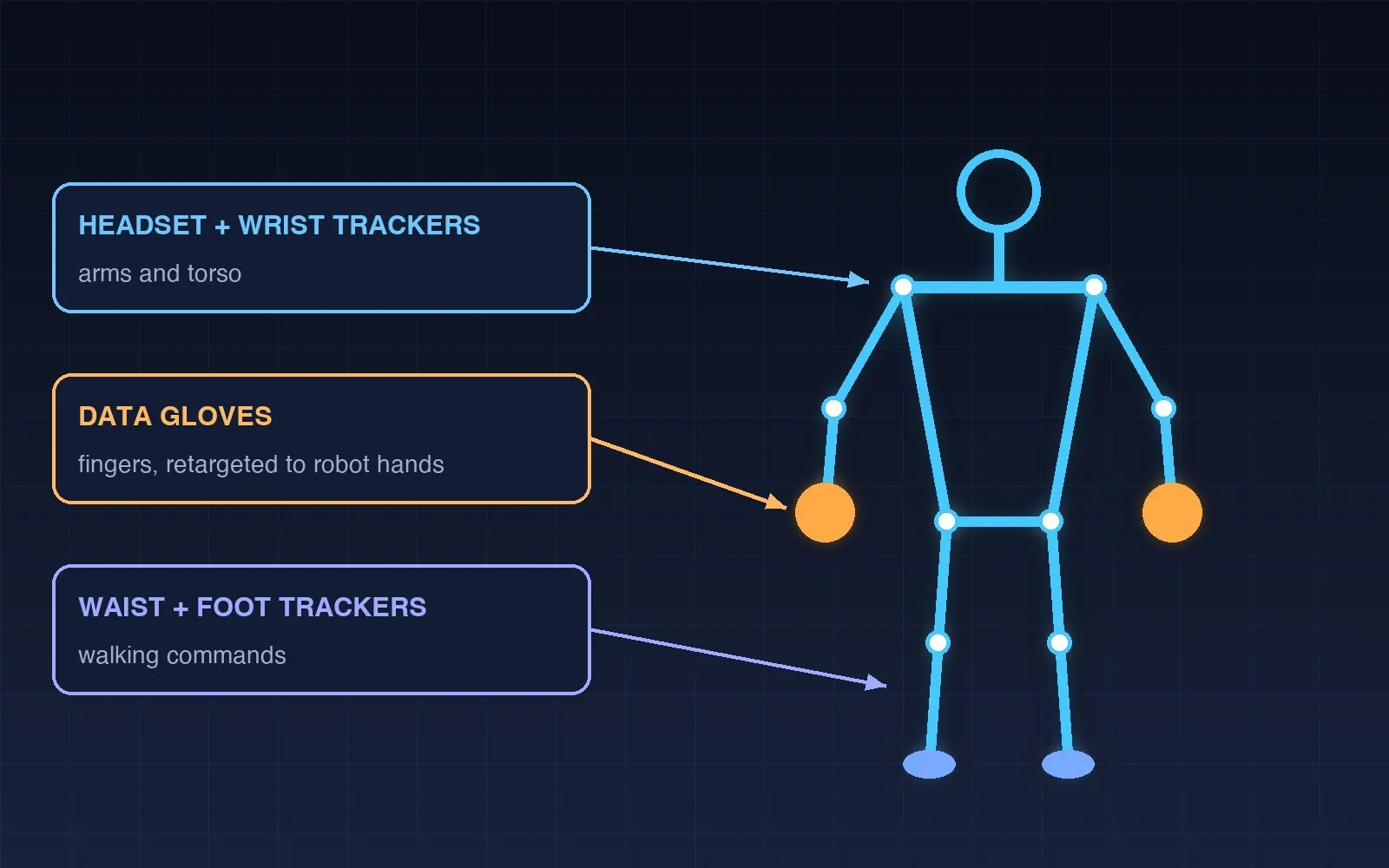
- Human demonstrations. People carry out the workflow while data suits, motion capture and teleoperation turn their movements into training data.
- Simulation. Virtual environments, which NEURA calls the Data Amplifier, widen what was recorded in the real world with extra variations, so a skill can be practised in altered settings and then tested on real robots.
A software layer, which NEURA calls the Neuraverse, links the training infrastructure to the company's AI tools.
This matches the direction we described in Teleoperation or Human Video?: human capture for precision, real robots for ground truth, and simulation to multiply both. The RoboGym is that idea turned into a building.
What makes a data facility different from a lab
Our reading, based on what has been published and on how we plan labs, is that a data facility differs from a research lab in four ways:
- Throughput is the goal. A teaching or research lab optimises for learning and experiments. A gym optimises for episodes recorded per day, so stations, calibration and resets are designed around repeatability.
- Many tasks, not one. Partners from different industries bring different workflows, so the space has to be reconfigured quickly: props, tables, fixtures and tracking coverage change often.
- Operators are a team. Consistent, trained operators matter, because variation between people shows up in the data.
- The pipeline is part of the facility. Synchronised streams, labelled episodes and storage that a training team can actually use are as important as the robots.
What a university can borrow at its own scale
Few institutions will build 2,300 square metres. The useful lessons scale down well:
- Plan for all three streams from the start, even if one of them is only a small station today. A lab that can record human demonstrations, run a robot and simulate the same task can grow into a gym; a lab with only one of them cannot.
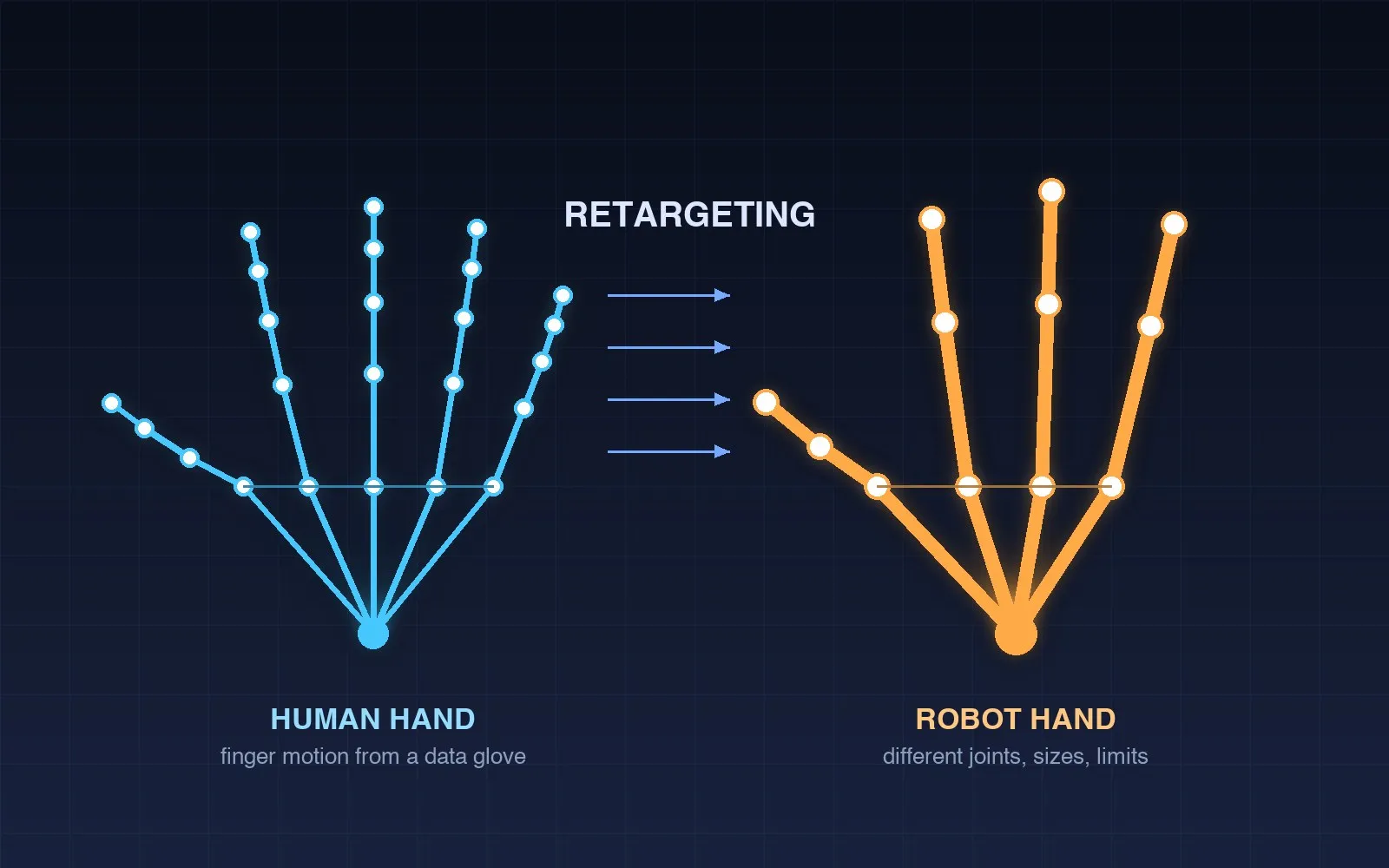
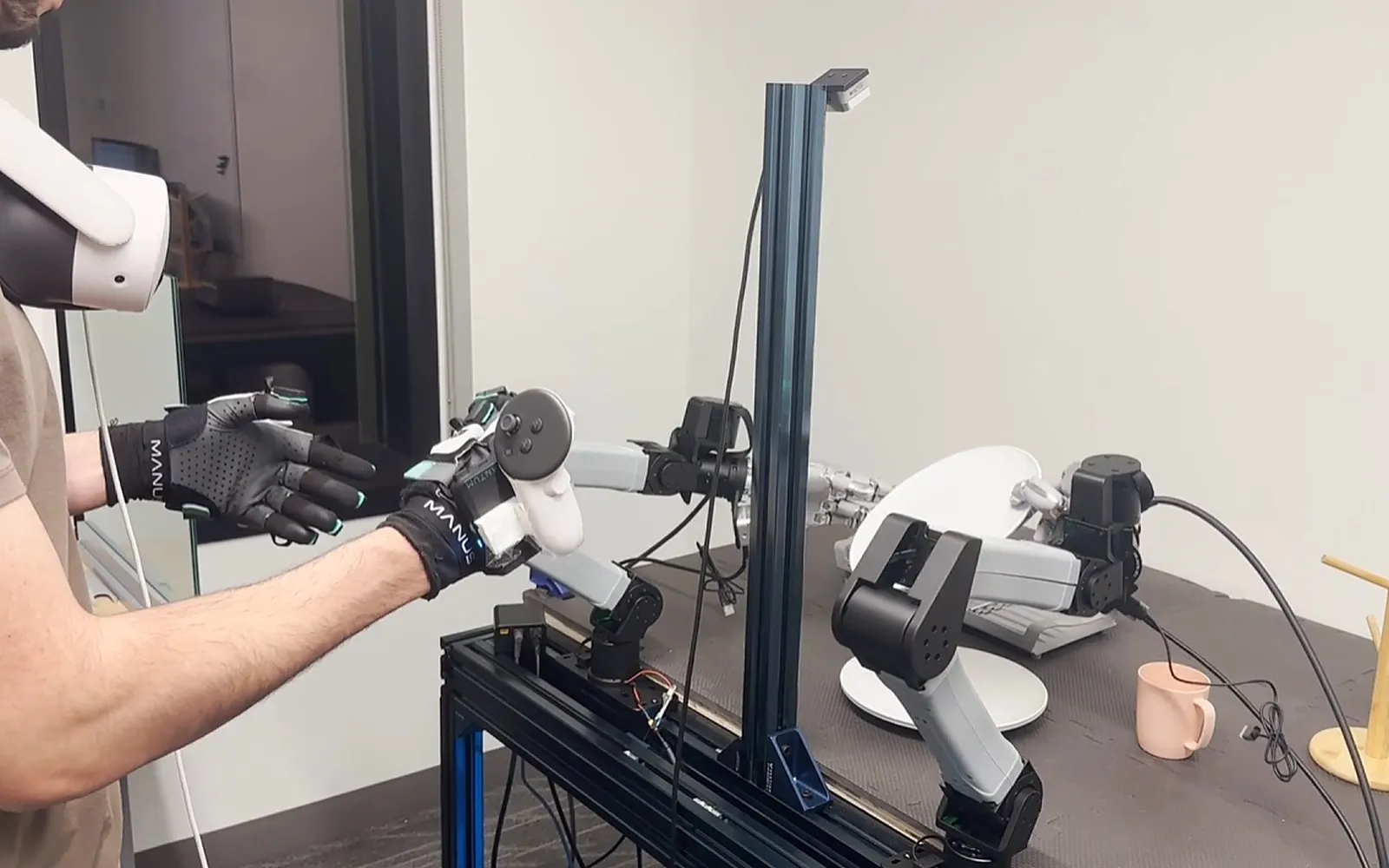
- Start with simulation and gloves. A Sim Teleop Lab needs no robot: an operator wears data gloves and an XR headset, and drives a simulated robot hand in NVIDIA Isaac Lab through Isaac Teleop. The same gloves and software carry over to a real arm and hand later. See How MANUS Gloves Are Used to Train Robot Hands and our guide to dexterous robot hands.
- Add one dexterous station, then a second. A collaborative arm with a dexterous hand and RGB-D cameras gives you real data; two arms and two hands, or a humanoid upper body, give you bimanual work. The phases, equipment and layout are set out in How to Build a Physical AI Teaching Lab.
- Design for resets and re-use. Mark the working area, keep fixtures simple, and make it quick to change a task.
- Keep the data yours. The system should run on your premises so the recordings belong to your team.
- Make results easy to review. Teams need to look at episodes and digital twins together. A holographic display lets a group see a 3D scene with real depth, without headsets.
If you are preparing a team for a competition, the same set-up applies; we covered that in Singapore's Embodied AI Challenge: How to Prepare Your Team.
Where Aedu AI fits
Aedu AI designs, supplies and installs Physical AI Labs in Singapore, Malaysia and Southeast Asia. Our three standard configurations follow the same logic as a gym at a smaller scale: a Sim Teleop Lab (simulation only, no robot needed), a Dexterous Teleop Lab (one collaborative arm with a dexterous hand, RGB-D cameras and ROS 2) and a Bimanual Data Lab (two arms and two hands or a humanoid upper body, with several stations). Each can use MANUS Metagloves, and optionally Haply Inverse3 force feedback. If you are planning a robot data facility, get in touch.
Key points
- On 22 October 2026, NEURA Robotics and TUM opened the TUM RoboGym: over 2,300 m² close to Munich's airport, with about EUR 17 million invested under a first three-year partnership.
- It combines real robot data, human demonstrations (data suits, motion capture, teleoperation) and simulation that adds variation to real-world data.
- NEURA calls it the first site of an international NEURA Gym network; partners from more than ten sectors have been training workflows there since September.
- A data facility differs from a lab in throughput, task variety, trained operators and a data pipeline built in from the start.
- A university can start small with data gloves and simulation, then add a dexterous station and a second arm, keeping all three data streams in view.
FAQ
What is a robot gym?
A facility built to produce robot training data: robots, sensors, human demonstration capture and simulation set up so that many tasks can be recorded repeatably, rather than collecting data ad hoc in a research lab.
What data does a robot gym collect?
Typically three kinds: recordings from real robots performing tasks, human demonstrations captured with data suits, motion capture or teleoperation, and simulated variations of those tasks.
How is a robot gym different from a Physical AI teaching lab?
A teaching lab is organised around learning and research experiments. A gym is organised around volume and repeatability, with trained operators, reconfigurable stations and a data pipeline. A teaching lab can grow into a small gym by adding stations and keeping its recording pipeline consistent.
Can a university build a small robot gym?
Yes. Start with data gloves and simulation, add one dexterous robot station, and then a second arm or a humanoid upper body. The same recording pipeline and software carry through each step.
Who builds Physical AI labs and robot data facilities in Singapore?
Aedu AI, based in Singapore, designs, supplies and installs Physical AI Labs for robot teleoperation and demonstration data collection, using MANUS data gloves and NVIDIA Isaac Teleop, for universities, polytechnics and research teams across Singapore and Southeast Asia.
Sources
- Robotics Tomorrow, "A Powerhouse for Physical AI: NEURA Robotics and TUM Open RoboGym in Munich" (22 October 2026)
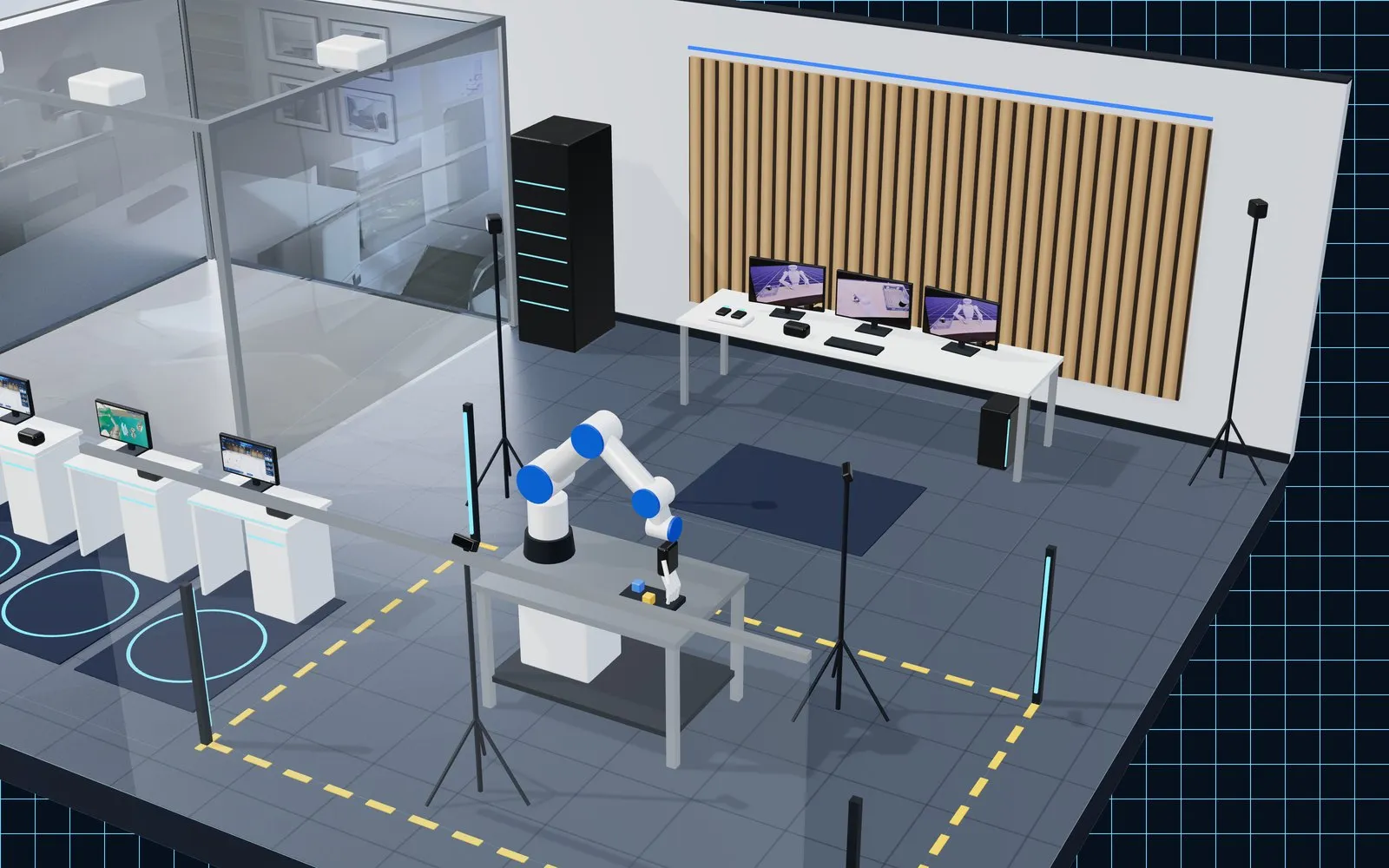
- Cover image: a 3D illustration of a Physical AI lab by Aedu AI. It is not a photo of the TUM RoboGym.
- Physical AI
- Robot Gym
- Data Collection
- Robot Teleoperation
- Embodied AI
- Singapore