On 22 October, Singapore's National Robotics Programme, A*STAR, PINE Lab at NTU and Micron Technology launched the Singapore Embodied AI Challenge for Manufacturing. It is the country's first national competition for embodied AI, and the task is not a toy. Teams have to program robots to open a semiconductor equipment chamber, remove and reinstall components, inspect them, clean surfaces and put everything back together, on a 3D mock-up chamber built by Micron.
The online simulation phase is already running and closes on 31 December 2026. The best teams go to an on-site final at RoboSG! 2027 on 20 March 2027, where their robots have to do the same job in a physical arena, against the clock.
That structure, simulation first and then the real robot, is exactly how embodied AI is being built in industry right now. This article explains what the challenge involves, why the task is harder than it looks, and how a university or company team can set itself up to do well in both phases.
What the challenge involves
The key facts, as reported at launch:
- Organisers: National Robotics Programme (NRP), A*STAR, PINE Lab@NTU and Micron Technology, with Micron providing the use case, sponsorship and technical expertise.
- Track: One track for the first edition, semiconductor manufacturing.
- Task: Open a chamber, remove and reinstall components, inspect, clean surfaces and reassemble, on Micron's mock-up of a real tool chamber.
- Phase 1: An online simulation phase, running now until 31 December 2026. Teams receive simulation data, synthetic datasets, baseline models and evaluation tools.
- Phase 2: On-site finals on 20 March 2027 at RoboSG! 2027. Finalists deploy their solutions in a physical arena and complete the assembly tasks within a time limit. They are ranked by the number of operational steps completed.
- Partners: Lightwheel supports simulation, benchmarking and evaluation. The National Supercomputing Centre Singapore provides AI cloud compute. Galbot provides the robot platform, developer toolkit and support for real-world data collection, and Infineon provides sensor technology.
- Who can enter: Teams of one to five people from anywhere in the world, including students, engineers, researchers and startups. Academia–industry teams are encouraged, and shortlisted overseas teams can get travel subsidies.
- Prizes: S$88,000 in total, with S$50,000 for the winner.
Check the official rules before you plan anything around tools or data. The launch coverage does not say which simulator teams will use, or what outside data and models are allowed.
Why a chip-tool chamber is a hard robotics problem
Picking up a cup is a solved demo. Servicing an equipment chamber is not, for four reasons.
- It is long-horizon. The task is a sequence of dependent steps, and ranking is by steps completed. A policy that is 95 percent reliable per step still fails often over a long chain, so recovery from small errors matters as much as raw skill.
- It is contact-rich. Opening a lid, seating a component and wiping a surface all depend on force and contact, which are exactly what simulators approximate least well.
- Tolerances are tight. Components in semiconductor tools have to go back in the right place and the right orientation. "Close enough" in simulation can be a jam on the real hardware.
- Cleanliness is part of the job. In a real fab, how you handle parts and surfaces matters as much as whether the part is in. We wrote about why human handling is a contamination risk in our article on VR cleanroom training, and the same logic applies to robots that touch critical surfaces.
This is why the challenge is useful even for teams that do not win. It forces you to deal with the problems that stop real deployments.
Phase one: getting the simulation work right
Most teams will spend October to December in simulation. Three choices decide how far they get.
- Pick a learning approach that fits the task. For long, structured manipulation sequences, imitation learning from demonstrations is usually the fastest route to a working baseline. Policies such as ACT or Diffusion Policy, or fine-tuning a vision-language-action model such as NVIDIA GR00T, all learn from recorded episodes. Reinforcement learning can then polish individual skills, such as seating a part, where the reward is easy to define.
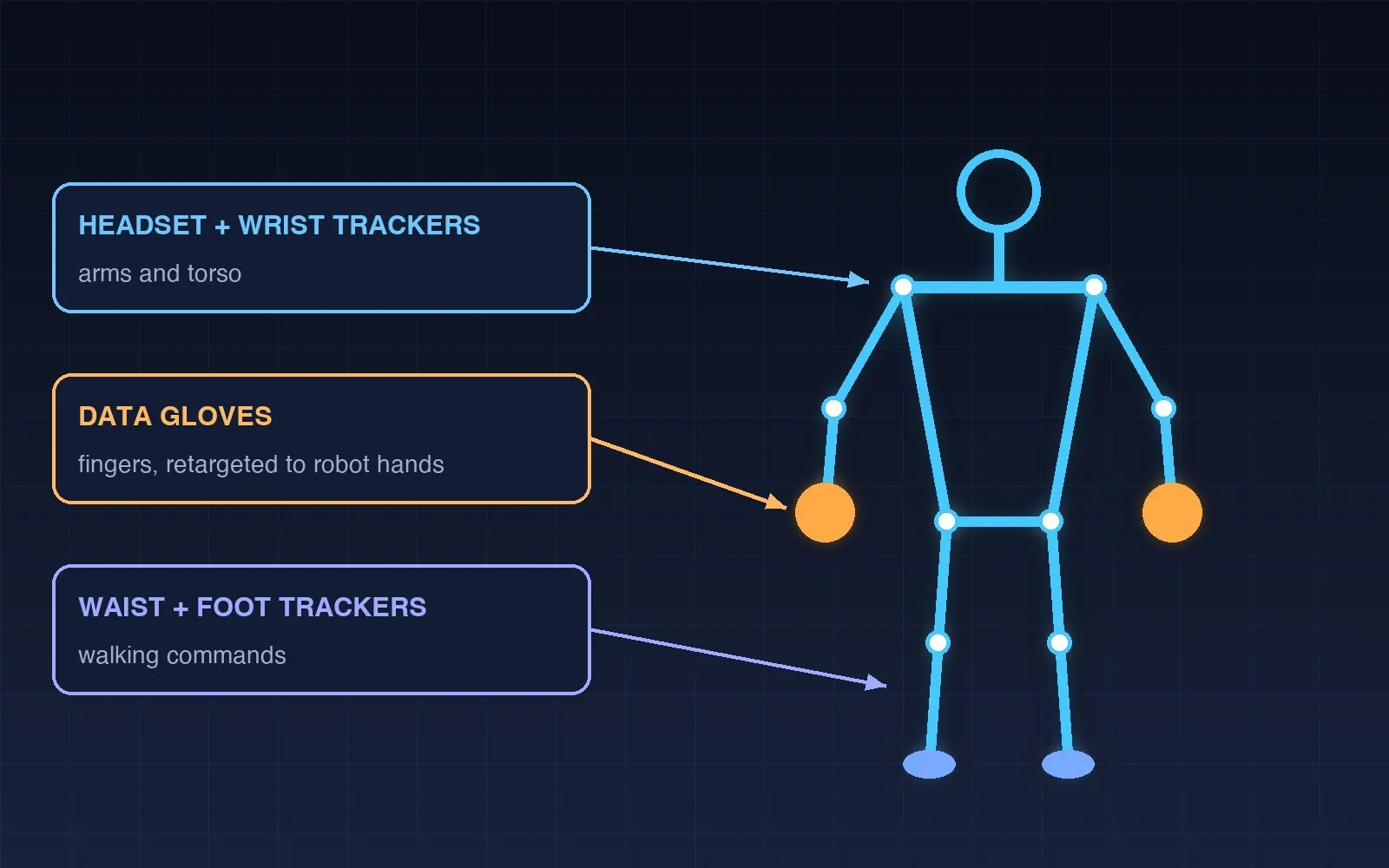
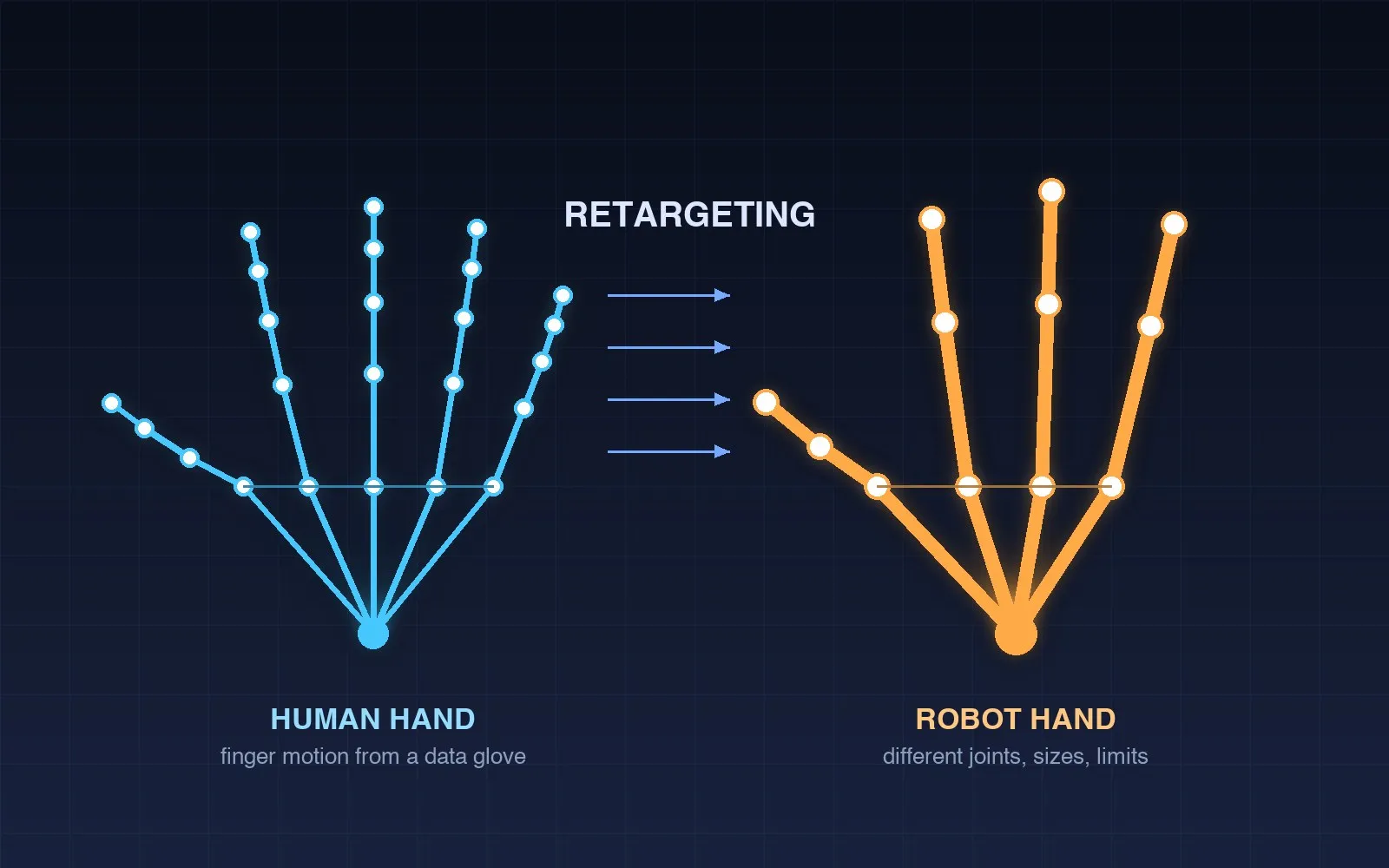
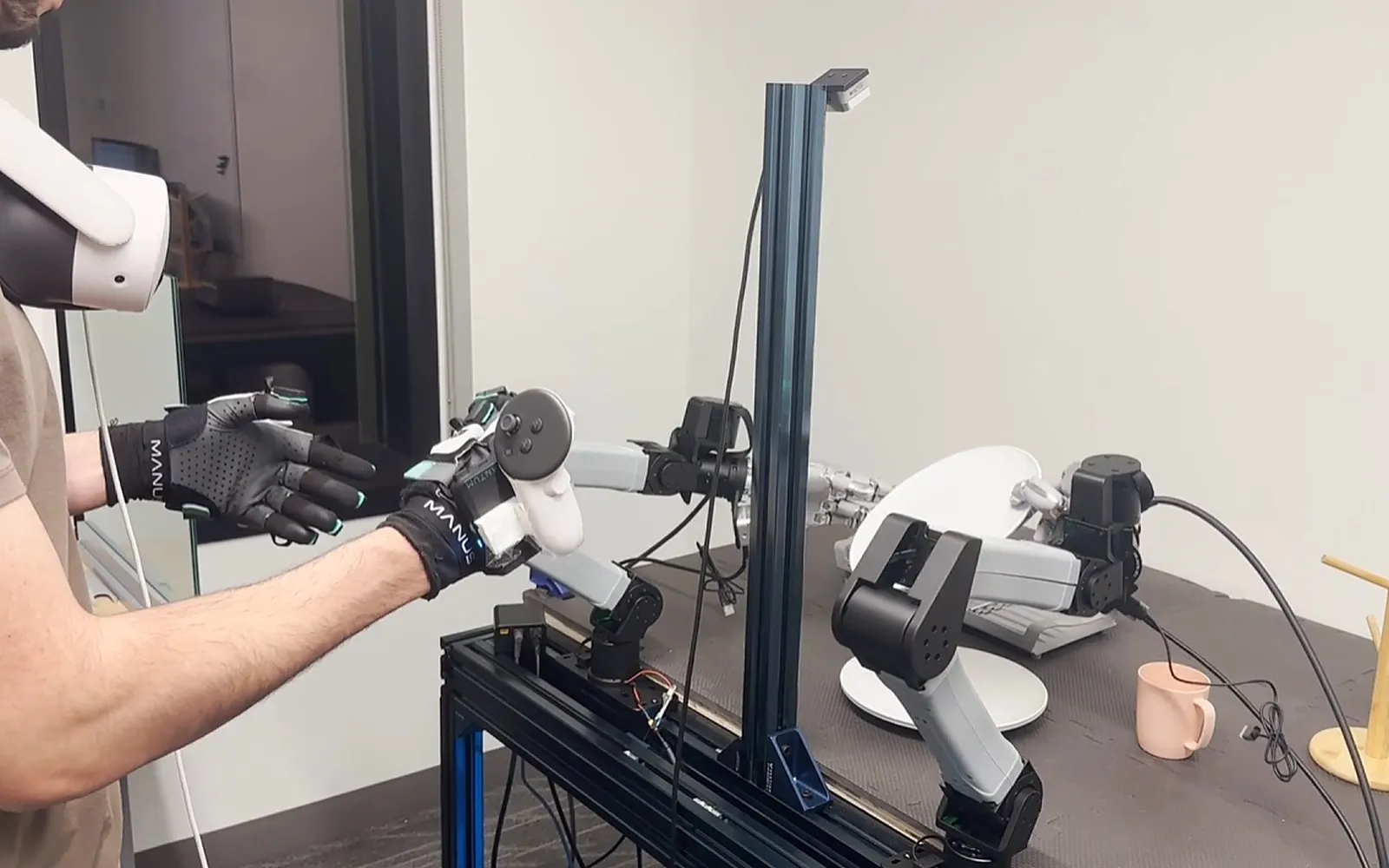
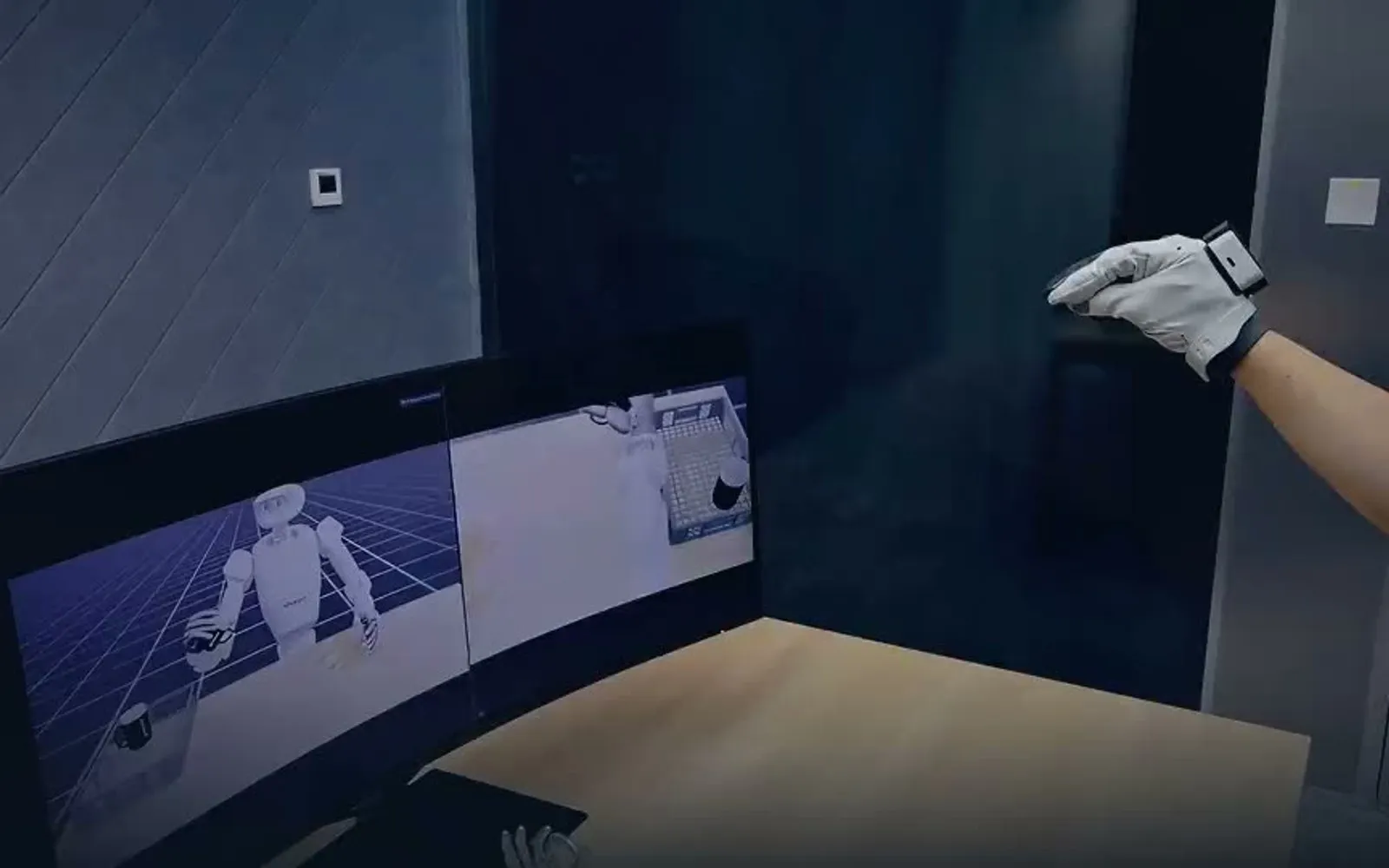
- Collect good demonstrations, not just many. Demonstrations recorded by teleoperating the simulated robot are clean, cheap and easy to reset. Hand-tracking data gloves and an XR headset let an operator perform the task naturally, and every attempt becomes a timestamped episode. According to NVIDIA's customer story on Lightwheel, the challenge's simulation partner, Lightwheel works at a 100:1 ratio of simulated to real data, building on NVIDIA Isaac Sim and Isaac Lab. Simulation is where the volume comes from.
- Randomise for the real world from day one. Policies trained on one perfect scene break on real hardware. Randomising physics parameters (friction, mass, joint damping) and visual parameters (textures, lighting, camera pose) during training is the standard way to make policies transfer, and Isaac Lab supports it natively. Do it early, not in February.
Treat the evaluation tools as your most important asset. Log which step each failure happens on, keep every dataset and model version, and fix the step that fails most often before you add anything new. That habit matters even more in the finals, where the score is steps completed.
Phase two: preparing for the real robot
The jump from simulation to the physical arena is where many teams lose. Finalists get access to the Galbot platform and real-world data collection support, so plan the January to March window carefully.
- Calibrate before you train. Camera intrinsics and extrinsics, robot-to-camera transforms and the arena layout should match your simulation before any real data is recorded.
- Collect a small, targeted set of real demonstrations. Use them to fine-tune the policy you trained in simulation, focusing on the contact-heavy steps where simulation and reality differ most.
- Practise recovery. Record demonstrations that start from a slightly wrong state, such as a lid half open or a part misaligned, so the policy learns to get back on track instead of stopping.
- Rehearse against the clock. Run the whole sequence end to end under the time limit, many times. Long-horizon tasks fail at the joins between steps, not inside them.
How to structure a team
A team of up to five works best with clear roles:
- Learning and simulation lead: trains and evaluates policies, and manages datasets and experiments.
- Teleoperation and data lead: records demonstrations in simulation and on the real robot, and keeps episodes clean and labelled.
- Robotics and integration lead: calibration, ROS 2 integration, safety and the physical setup for the finals.
- Team lead: tracks the step-level scores, decides what to fix next and handles the rules and submissions.
A mixed academia–industry team, which the organisers encourage, is a good way to cover all four.
A lab setup that outlasts the challenge
A team that builds a proper demonstration pipeline for this challenge ends up with something a teaching lab can use for years. A practical progression looks like this:
- Start in simulation, no robot needed. One pair of MANUS data gloves, an XR headset, wrist trackers and an RTX-class GPU workstation running Isaac Sim, Isaac Lab and Isaac Teleop. An operator drives a simulated robot hand and records episodes from the first week.
- Add real hardware when you need it. A collaborative arm with a dexterous hand and two or three RGB-D cameras, driven over ROS 2 by the same gloves. Haptic gloves, or a force-feedback device such as the Haply Inverse3, let operators feel contact, which matters for the press, seat and wipe steps in a task like this one.
- Export to standard formats. HDF5 or LeRobot datasets, ready for ACT, Diffusion Policy or GR00T fine-tuning, so the work is not tied to one competition's tooling.
We explain the full layout, including room plans and configurations, in How to Build a Physical AI Teaching Lab. For the trade-offs between teleoperated data and learning from human video, see Teleoperation or Human Video?.
How Aedu AI helps
Aedu AI is a Singapore company that designs, installs and supports Physical AI Labs for robot teleoperation and demonstration data collection. A lab is built on MANUS Metagloves and NVIDIA Isaac Sim, Isaac Lab and Isaac Teleop, with ROS 2 for real robots. We offer three standard configurations, from a simulation-only teleoperation lab on a single desk to multi-station bimanual data collection. We handle setup, calibration and operator training, and the data stays on your workstation in open formats.
If your university, polytechnic or company team is entering the challenge, or wants a lab that can support the next edition, use Get in touch on any page or read more about Aedu AI. For the bigger picture of where Singapore sits in the physical AI race, see Physical AI's Data Race, and Where Singapore Fits In.
Key points
- The Singapore Embodied AI Challenge for Manufacturing launched on 22 October 2026. It is the country's first national embodied AI competition, built on a real Micron use case.
- Teams must open, service and reassemble a semiconductor equipment chamber. The simulation phase runs to 31 December 2026, and the finals are at RoboSG! 2027 on 20 March 2027.
- The task is long-horizon and contact-rich, and it is scored by steps completed, so reliability and error recovery matter as much as raw capability.
- Strong teams combine imitation learning from teleoperated demonstrations, domain randomisation from day one and disciplined step-level evaluation.
- The finals reward careful calibration, targeted real-world fine-tuning and end-to-end rehearsal under the time limit.
FAQ
Who can enter the Singapore Embodied AI Challenge?
Teams of one to five people from anywhere in the world, including students, engineers, researchers and startups. Academia–industry teams are encouraged, and shortlisted overseas teams can apply for travel subsidies.
Do we need our own robot to take part?
Not for the first phase, which runs entirely in simulation. Finalists work with the Galbot platform provided by the organisers. Having a simulation teleoperation setup of your own still helps, because it lets you record demonstrations and test ideas between submissions.
Which simulator does the challenge use?
The launch announcement names Lightwheel as the simulation and evaluation partner but does not name a specific simulator. Check the official rules. Lightwheel's own tooling is built on NVIDIA Isaac Sim and Isaac Lab.
Is imitation learning or reinforcement learning better for this task?
For a long sequence of structured steps, imitation learning from good demonstrations usually gets a working baseline fastest. Reinforcement learning is useful for polishing individual skills with clear rewards. Many strong teams combine the two.
Can a teaching lab built for the challenge be used afterwards?
Yes. A demonstration and teleoperation pipeline built on open formats such as HDF5 and LeRobot supports robotics courses, final-year projects and research long after the competition ends.
Sources
- TNGlobal, "Singapore launches first national Embodied AI Challenge to accelerate real-world robotics deployment in manufacturing" (22 October 2026): https://technode.global/2026/10/22/singapore-launches-first-national-embodied-ai-challenge-to-accelerate-real-world-robotics-deployment-in-manufacturing/
- NVIDIA, "Lightwheel" customer story: https://www.nvidia.com/en-us/case-studies/lightwheel/
- TechNode, "How far are robots from actually working on production lines? Galbot's industrial AI journey" (27 August 2026): https://technode.com/2026/08/27/how-far-are-robots-from-actually-working-on-production-lines-galbots-industrial-ai-journey/
- "Isaac Lab: A GPU-Accelerated Simulation Framework for Multi-Modal Robot Learning" (arXiv 2511.04831): https://arxiv.org/pdf/2511.04831
- Embodied AI Challenge
- Physical AI Singapore
- Robot Learning
- Sim-to-Real
- Semiconductor Manufacturing
- Teleoperation