October brought a run of headlines with the same message. Robotics and physical AI companies have raised close to US$48 billion so far in 2026, according to PitchBook data reported by the Financial Times, and a large share of that money is going into data. Labs such as Physical Intelligence, Skild AI, NEURA Robotics and Generalist are building their own data operations alongside outside vendors: "robot gyms" where people guide robot arms through tasks, and recording equipment in homes, offices and factories to capture how people move, touch and apply force.
Language models learned from the internet. Robots have no internet of physical experience to learn from, so the industry is building one.
Why data is the bottleneck
MIT Technology Review put the problem plainly on 8 October: "There is no corresponding pool of high-quality physical demonstrations on which to train robots." Robots learn most skills through imitation learning, and today's most capable robot models, including Google DeepMind's Gemini Robotics and Physical Intelligence's π0, were trained on large sets of human demonstrations, mostly collected by people remotely guiding robots.
Every way of getting that data has a cost:
- Teleoperation produces exactly the data a robot needs, but it is slow and expensive.
- Video of people is plentiful, but it carries no robot actions, forces or contact.
- Learning in the field is realistic, but unsafe and unreliable while the robot is still learning.
That is why no single method has won, and why labs are investing in several at once.
Four ways labs are collecting data in 2026
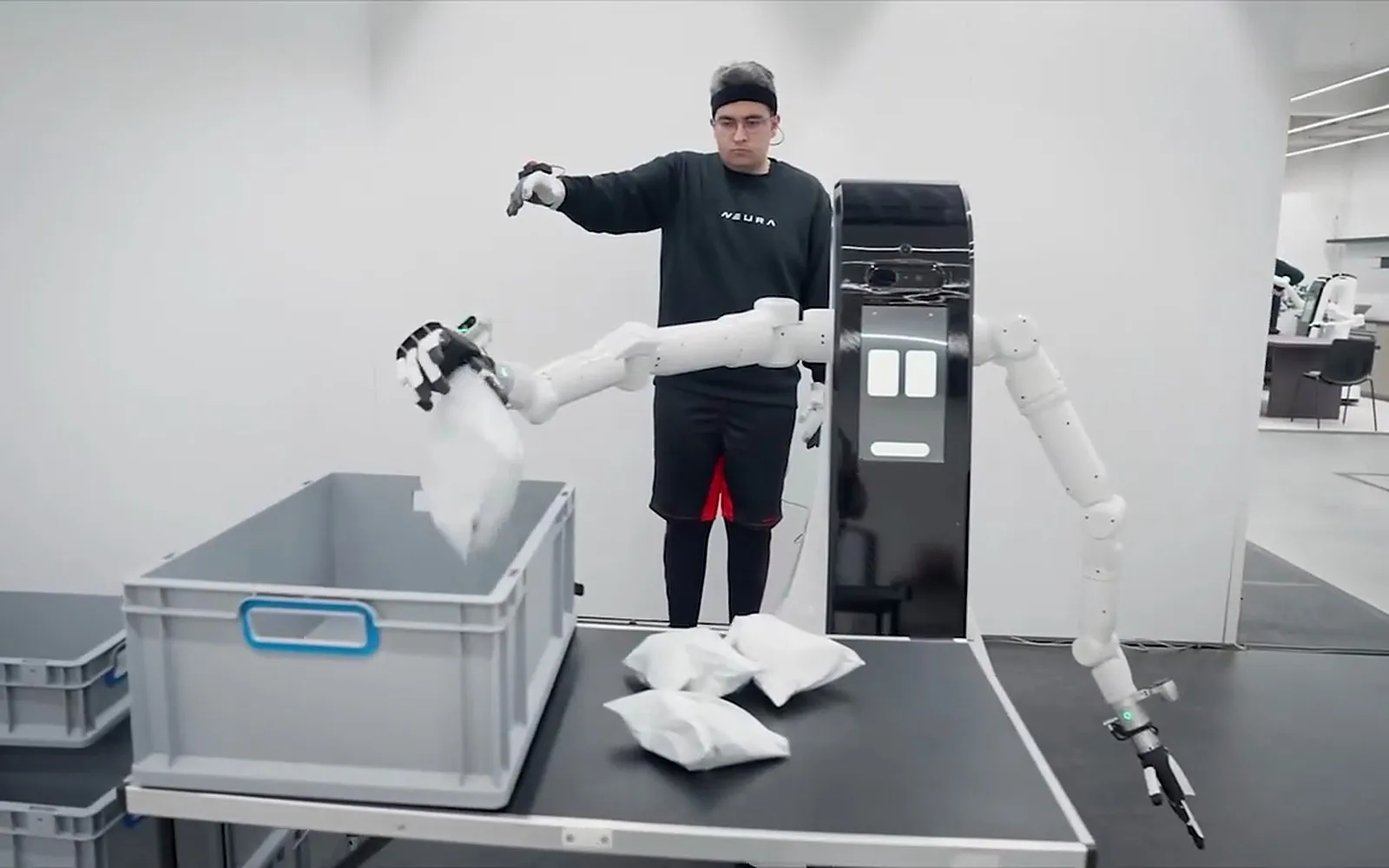
1. Robot gyms and teleoperation at scale. NEURA Robotics calls high-quality real-world training data "Physical AI's scarcest resource" and is building NEURA Gyms with RWTH Aachen University and the Technical University of Munich, with five locations across Europe, the U.S. and China planned to be running by the end of 2026. Scale AI says it now adds more than 1,000 hours of demonstration data to its platform every day, and in March it partnered with Universal Robots to collect visual and force-feedback data from production robots.
2. Egocentric human video. Dyna Robotics says its Dyna-2 model was pretrained on more than one million hours of video filmed from the performer's point of view. In the company's own benchmarks, scaling from 1,000 to one million hours raised its average score across 14 tasks from 20% to 53%. Video brings scale; post-training on a few hours of real robot data turns it into robot behaviour.
3. Direct 3D motion capture. Innodata opened a motion-capture lab in New Jersey at the end of September, recording movement in 3D with sub-millimetre optical tracking rather than estimating it from 2D video. "There's just no substitute for direct 3D motion capture," said Frank Tanner, its VP of robotics and physical AI.
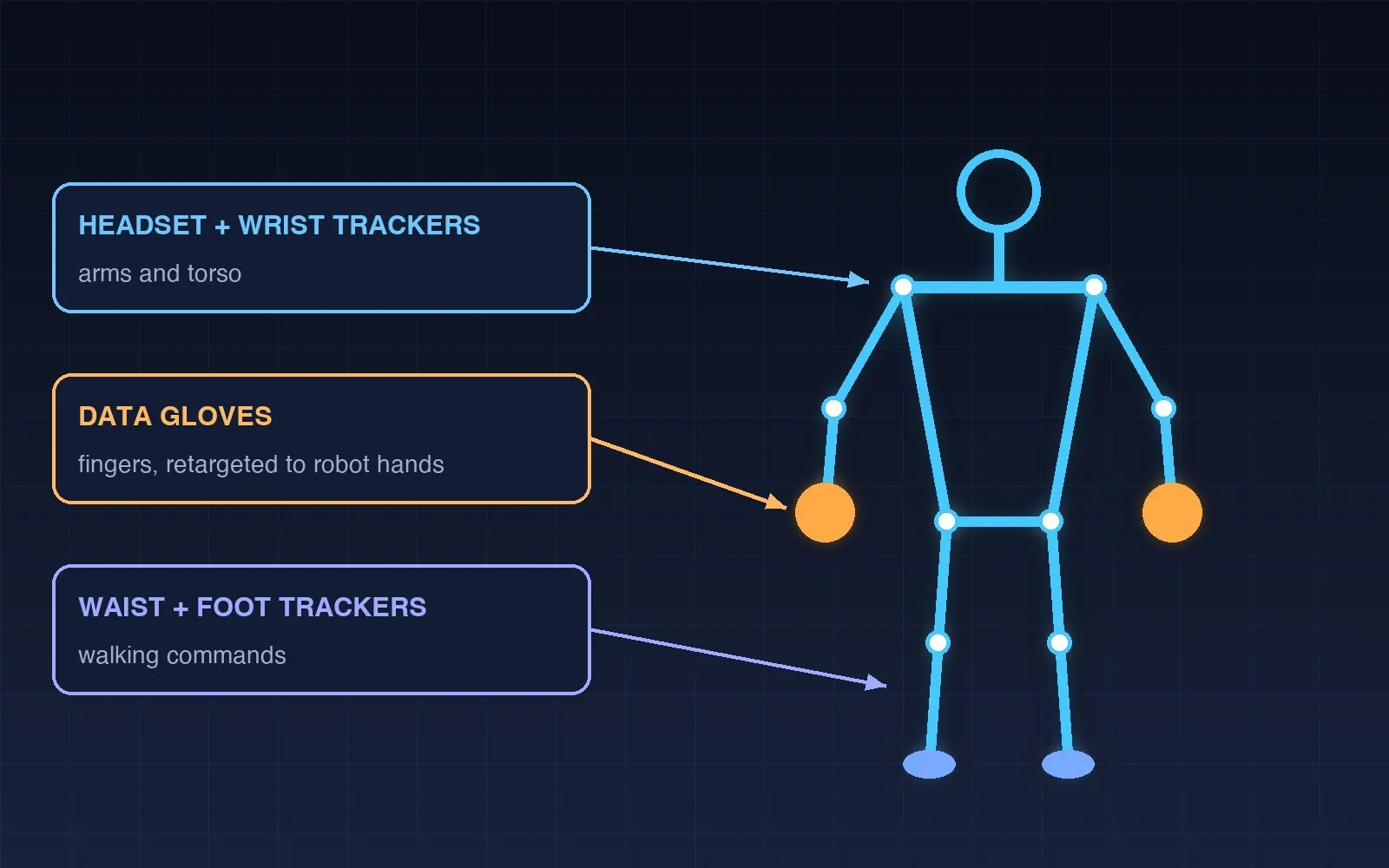
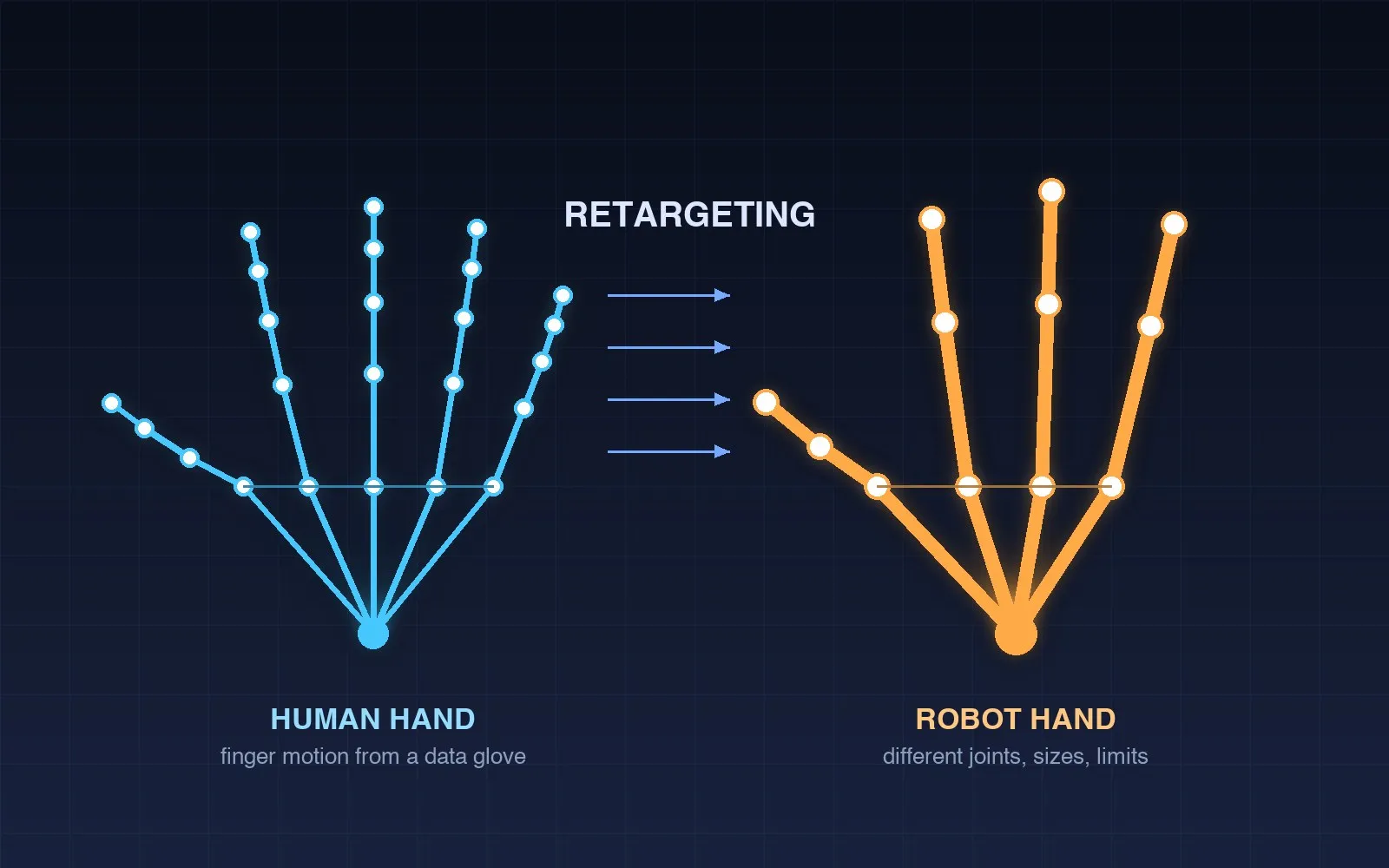
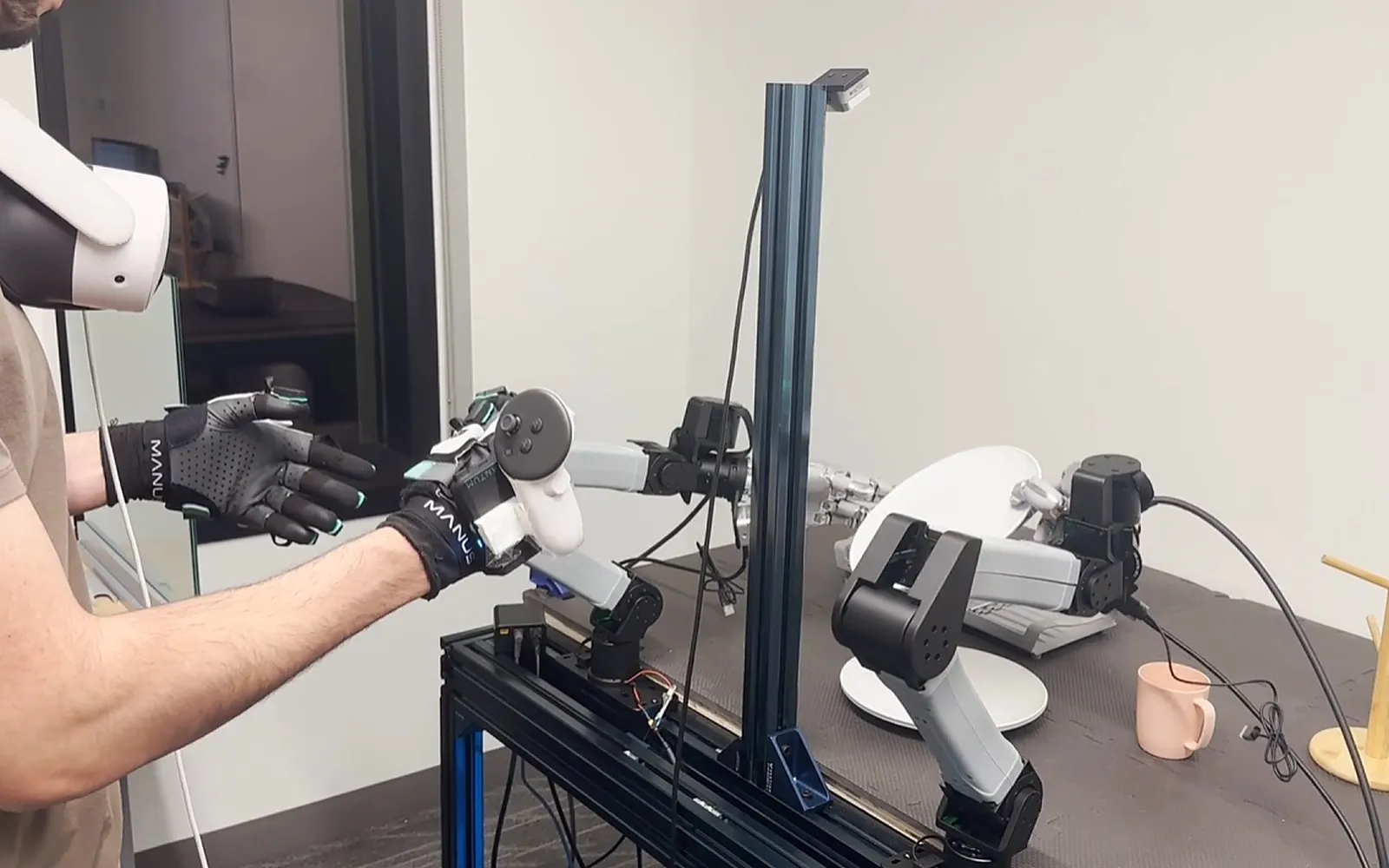
4. Data gloves for dexterous hands. For hands, the hard part is the moment fingers close around an object and disappear from a camera's view. Electromagnetic data gloves keep tracking through that moment and drive a robot hand live. We covered this in detail in How MANUS Gloves Are Used to Train Robot Hands in 2026.
What the leaders have in common
Look past the different methods and the same priorities appear:
- Quality over raw volume. Noisy or drifting motion data teaches robots the wrong thing. Precise capture of fingers, contact and force is worth more than extra hours of rough footage.
- Force and touch, not just motion. Scale AI's force-feedback data with Universal Robots and haptic teleoperation gloves both point the same way: robots need to learn how hard to grip, not only where to move.
- A real data pipeline. Synchronised streams, consistent operators, labelled episodes and storage that a training team can actually use. The rigs are the visible part; the pipeline is what makes the data usable.
- Hybrid strategies. Most serious teams combine teleoperation, video and simulation rather than betting on one source.
Singapore's physical AI push
Singapore is positioning itself as a place to develop and deploy physical AI, not just to read about it.
On 20 May 2026, IMDA, JTC and the Singapore Institute of Technology announced a living testbed for autonomous robots in the Punggol Digital District, with eight industry partners including Certis, DHL, Grab, QuikBot, FieldAI, Thoughtworks, Slamtec and Unitree. JTC describes it as Singapore's first testbed to deploy robots from multiple operators in a mixed-use public area, trialling services such as delivery, cleaning and security patrols. It is due to launch later in 2026. SIT is also setting up a Centre for Intelligent Robotics in the district, where Slamtec, Unitree and QuikBot will develop and trial embodied AI use cases.
Industry is moving in too. Sharpa, which makes general-purpose robots with human-like dexterity and has its global headquarters in Singapore, announced partnerships in April with A*STAR's Institute for Infocomm Research to develop robotic capabilities for container handling at ports, and with JTC and Grab to deploy and test robots in Punggol.
What this means for universities and research teams
For universities, polytechnics and research institutes in Singapore and Southeast Asia, this is the moment to build in-house capability in robot teleoperation and embodied AI data collection. Testbeds and deployments need two things that universities are well placed to provide: people who know how to teach robots, and the data to teach them with. A teaching or research lab that can record clean demonstrations gives students hands-on experience with the same workflow the industry is scaling up, and gives researchers their own data rather than relying on someone else's.
A lab does not need to start big. Most begin with gloves and simulation, add one dexterous robot station, then scale to bimanual collection. We set out the equipment, software and layout for each phase in How to Build a Physical AI Teaching Lab.
Aedu AI designs, supplies and installs Physical AI Labs in Singapore and the region, from the first glove to a multi-station data lab. If you are planning one, .
Key points
- Robotics and physical AI companies have raised close to US$48 billion in 2026, much of it aimed at training data (PitchBook via the Financial Times).
- There is no large pool of high-quality physical demonstrations; teleoperation, human video and field learning each have trade-offs.
- Leading labs are investing in robot gyms, egocentric video, direct 3D motion capture and data gloves, and most combine several.
- Quality, force and touch data, and a usable data pipeline matter more than raw hours.
- Singapore's Punggol Digital District testbed (IMDA, JTC, SIT and eight partners) launches later in 2026, and SIT is setting up a Centre for Intelligent Robotics there.
FAQ
What is physical AI?
AI that perceives and acts in the physical world through robots and machines, rather than only producing text or images.
Why can't robots just learn from internet videos?
Videos show what people do but not the robot's joint commands, the forces involved or what contact feels like. Most teams use video for scale and teleoperated demonstrations for precision.
What is teleoperation data?
Recordings made while a person controls a robot remotely, for example with data gloves and an XR headset. Each recording pairs what the robot saw with the actions it took, which is what imitation learning needs.
Can a university start without a robot?
Yes. Teams can teleoperate simulated robot hands in NVIDIA Isaac Lab first and add a real arm and hand later with the same gloves and software.
Who builds Physical AI labs in Singapore?
Aedu AI, based in Singapore, designs, supplies and installs Physical AI Labs for robot teleoperation and demonstration data collection, using MANUS data gloves and NVIDIA Isaac Teleop, for universities, polytechnics and research teams across Singapore and Southeast Asia.
Sources
- AI Weekly, summary of the Financial Times report on robotics and physical AI funding (11 October 2026)
- MIT Technology Review, "AI breakthroughs in robotics won't change your life any time soon" (8 October 2026)
- TokenPost, "Robotics Firms Expand Data Collection for Physical AI Training" (13 October 2026)
- JTC, "Singapore Government and Eight Industry Leaders to Research, Test and Deploy Physical AI in Punggol Digital District" (20 May 2026)
- Singapore EDB, Sharpa AI Robotics Summit (28 April 2026)
- Cover image: teleoperation demonstration with MANUS data gloves, courtesy of MANUS.
- Physical AI
- Robot Learning
- Teleoperation
- Data Collection
- Singapore