On 6 October, Malaysia's Ministry of Investment, Trade and Industry told Parliament that 21,391 people had been trained for the semiconductor sector as of June 2026. The target under the National Semiconductor Strategy is 60,000 by 2030. Vietnam has set itself an even steeper climb: at least 50,000 people with university degrees across the chip value chain by 2030. Singapore, which already makes about one in ten of the world's chips, had nearly 1,000 openings at a single semiconductor career fair in January.
Every one of these plans runs into the same physical limit. You cannot learn to work in a cleanroom without being in one, and cleanroom time is the most expensive, most crowded and least forgiving training space there is.
This article looks at the talent numbers across the region, why cleanroom access is the real bottleneck, and how VR cleanroom training can take the first, most error-prone hours of practice out of the real facility. It is more technical than our usual posts, because the details decide whether a module helps or just looks impressive.
The semiconductor talent gap in three countries
Malaysia. The National Semiconductor Strategy, announced by Prime Minister Anwar Ibrahim in May 2024, aims to train and upskill 60,000 high-skilled Malaysian engineers, backed by at least RM25 billion in fiscal support. MITI's latest figure puts the country about a third of the way there. Malaysia's TVET planners also list semiconductors among the priority sectors for new training places, which we covered in our article on Budget 2027 and VR simulation labs.
Vietnam. Decision 1017/QD-TTg, signed in September 2024, sets targets for 2030: at least 50,000 people with a university degree or higher across the chip value chain, including at least 42,000 engineers and bachelor's graduates, 5,000 AI specialists for the industry and intensive training for 1,300 lecturers. The state budget will support four national shared-use semiconductor laboratories and in-house labs at around 18 public universities.
Singapore. The Economic Development Board puts the semiconductor workforce at over 35,000 people, in a sector that contributes about one in ten chips worldwide and one-fifth of global semiconductor equipment production. ITE has signed agreements with chipmakers for internships and hands-on training, and the number of Higher Nitec Electronics Engineering students choosing semiconductor modules doubled from 80 in 2023 to 160 in 2026.
The scale differs, but the training problem is the same. Classrooms can teach device physics and process theory. What they cannot easily provide is enough supervised time inside a cleanroom.
Why cleanroom time is the bottleneck
A training cleanroom is costly to build and run, and every person who walks in is a contamination risk. In a 2024 article for Cleanroom Technology, Koos Agricola put the emission from a person at between 100,000 and 10,000,000 particles of 0.5 micrometres or larger per minute, depending on the individual and what they are doing. Changing into garments, walking and arm movements all release or stir up particles.
Two consequences follow for training:
- Beginners are the riskiest people in the room. The habits that keep a cleanroom clean, such as gowning order, slow movement and keeping hands away from critical surfaces, are exactly what a new trainee has not learned yet.
- Shared labs mean scarce slots. When a country funds a few national shared laboratories, as Vietnam's decision does, every student hour inside has to count.
Agricola also makes a point that matters for how training is designed: people follow cleanroom rules better when they understand the mechanism behind them, not just the list of steps.
What others in the region are already doing
VR cleanroom training is not a new idea, and the most useful examples are close to home.
- In Da Nang in August 2025, FPT signed agreements with Plasma-Therm and the Da Nang Semiconductor and AI Center to build VR training for semiconductor production, maintenance and safety, including simulated cleanroom and chip production environments.
- At Eindhoven University of Technology, a pilot called Learning Semiconductor Cleanroom Skills in VR focuses on gowning, navigation, safety routines and basic tool operation. Its stated aim is to let students practise before they enter a real facility and to free cleanroom time for advanced work.
The pattern is consistent. VR handles the procedures, and the real cleanroom is kept for work that needs it.
How to design a VR cleanroom training module
Here is how we would approach a cleanroom module, using the same method we use for chemical plant and equipment maintenance training.
- Start from the facility's own procedures. Gowning SOPs, entry and exit rules, tool operating instructions and emergency procedures are the source material. Each step in the module maps to a line in a document the training team already owns.
- Score the gowning sequence step by step. Order matters. In a typical top-down sequence the hood goes on before the coverall, boots after it and gloves last, with a mirror check at the end, but the module follows the facility's own order. The module also flags contact errors, such as touching the outside of the garment with a bare hand. One critical error fails the attempt, just as a supervisor would stop a real entry.
- Make the invisible visible. This is where VR beats a video. A module can show the particle plume when a trainee moves too fast, or show laminar airflow being disturbed when an arm passes over a wafer carrier. Seeing the mechanism once is what makes the rule stick.
- Model the real tools at real scale. Load ports, wafer carriers, wet benches and inspection stations are rebuilt from drawings, photos and site visits. AI tools now speed this up considerably; we describe that workflow in From Photo to VR-Ready Asset.
- Train abnormal situations. Tool alarms, chemical spills and gas alarms that require evacuation are rare and cannot be rehearsed for real. In VR they can be practised until the response is automatic. Our VR safety training guide covers how to structure these.
- Choose the input method deliberately. Hand tracking feels natural for gowning and glove checks. Controllers are more reliable for precise tool operation. Many modules use both, depending on the step.
- Record every attempt. Order errors, contact errors, time per step and critical failures are logged for each trainee, so instructors can see which steps a cohort struggles with before anyone enters the real cleanroom.
Where VR stops
VR does not replace the real cleanroom, and a programme that pretends it does will disappoint.
- Touch and fit. The feel of a glove seal, a tight hood or a stiff coverall needs a real mock gowning area.
- Certification. Fabs and training centres decide when a person is cleared for entry. VR prepares people for that check; it does not replace it.
- Physical stamina. Working for hours in full garments is something people only learn by doing.
A practical layout combines all three: VR stations for procedure practice, a mock gowning room with real garments, and scheduled sessions in the training cleanroom for the final, supervised attempts.
What a semiconductor training lab could look like
For a university, polytechnic or TVET institute building semiconductor programmes, a lab built on this idea would include:
- VR stations for a half-class. Enough stations for half a class to practise while the other half works in the mock gowning area, then the groups swap.
- A teacher console. It shows every station's progress and lets the instructor push the next module to all seats.
- An immersive projection room or a CAVE. A whole class can walk through a full-scale fab layout together before anyone enters the real one.
- Modules on [AeduVerse](/products/aeduverse). This is our browser-based WebXR platform. It runs on PCs, mobile devices, VR headsets and CAVEs with nothing to install. Instructors can update steps, hotspots and questions themselves in AeduVerse Creator when a procedure changes.
How Aedu AI helps
Aedu AI is a Singapore company that designs, installs and supports XR Labs for universities, vocational schools and industrial training centres, including VR classrooms, CAVEs, industrial VR training rooms and virtual simulation training bases. For a cleanroom programme we would handle the site survey and floor plan, the hardware, installation, modules built from your procedures and equipment on AeduVerse, instructor training and support after handover. The lab runs on your premises, and training records stay with you.
You can see the labs we have built on our projects page, including a chemical equipment VR training lab where VR stations sit beside physical rigs. Read more about Aedu AI, or use Get in touch on any page to tell us which procedure you want to train first.
Key points
- Malaysia has trained 21,391 of its 60,000 semiconductor talent target as of June 2026.
- Vietnam aims for at least 50,000 degree-level semiconductor workers by 2030.
- Singapore's semiconductor workforce is over 35,000, and it makes about one in ten of the world's chips.
- Cleanroom time is the bottleneck. People are a major contamination source, and beginners are the riskiest people in the room.
- VR cleanroom modules should score gowning and behaviour step by step, make particles and airflow visible, model real tools and rehearse abnormal events.
- VR prepares trainees for the real cleanroom. It does not replace the mock gowning room or the facility's own entry certification.
FAQ
Can VR replace cleanroom training?
No. VR replaces the first attempts and the repetition of procedures. Trainees still need a mock gowning area with real garments and supervised time in a real training cleanroom before they are cleared to work.
What should a first VR cleanroom module cover?
Gowning and de-gowning, entry and exit procedures, and cleanroom behaviour. These are the steps beginners get wrong most often, and the ones that create the most contamination risk.
Is VR useful for semiconductor equipment maintenance?
Yes. Maintenance procedures with many steps, lockout and safety checks suit VR well, because trainees can rehearse the full sequence on a model of the real tool before they touch it.
Can instructors update modules when procedures change?
On AeduVerse, instructors edit steps, hotspots and questions in the browser and publish the update to their class, without waiting for a developer.
Do you work outside Singapore?
Yes. We are based in Singapore and also deliver labs for customers in other countries. Tell us where your institution or facility is and we will plan the survey, installation and support around it.
Sources
- Bernama, "MITI: 21,391 Semiconductor Talents Trained As Of June 2026" (6 October 2026): https://www.bernama.com/en/news.php?id=2616354
- Human Resources Online, "Five targets for Malaysia's National Semiconductor Strategy (NSS)" (30 May 2024): https://www.humanresourcesonline.net/five-targets-for-malaysia-s-national-semiconductor-strategy-nss
- LuatVietnam, "Decision 1017/QD-TTg 2024 Program on development of human resources for the semiconductor industry through 2030": https://english.luatvietnam.vn/cong-nghiep/decision-1017-qd-ttg-2024-program-on-development-of-human-resources-for-the-semiconductor-industry-through-2030-366646-d1.html
- Singapore Economic Development Board, "How is Singapore developing semiconductor talent to meet industry needs": https://www.edb.gov.sg/en/news-and-insights/how-is-singapore-developing-semiconductor-talent-to-meet-industry-needs
- Singapore Economic Development Board, "Singapore semiconductor sector boosts talent with 1,000 jobs" (29 January 2026): https://www.edb.gov.sg/en/news-and-insights/singapore-semiconductor-sector-boosts-talent-with-1000-jobs
- Koos Agricola, "Everything you need to know about human behaviour in cleanroom operations", Cleanroom Technology (19 March 2024): https://cleanroomtechnology.com/everything-you-need-to-know-about-human-behaviour
- FPT IS, "FPT is committed to seizing opportunities in the semiconductor industry together with Da Nang and Vietnam" (4 September 2025): https://fpt-is.com/en/fpt-executive-fpt-is-committed-to-seizing-opportunities-in-the-semiconductor-industry-together-with-da-nang-and-vietnam/
- Eindhoven University of Technology, "Learning Semiconductor Cleanroom Skills in VR": https://drive.tue.nl/projects/learning-semiconductor-cleanroom-skills-in-vr/
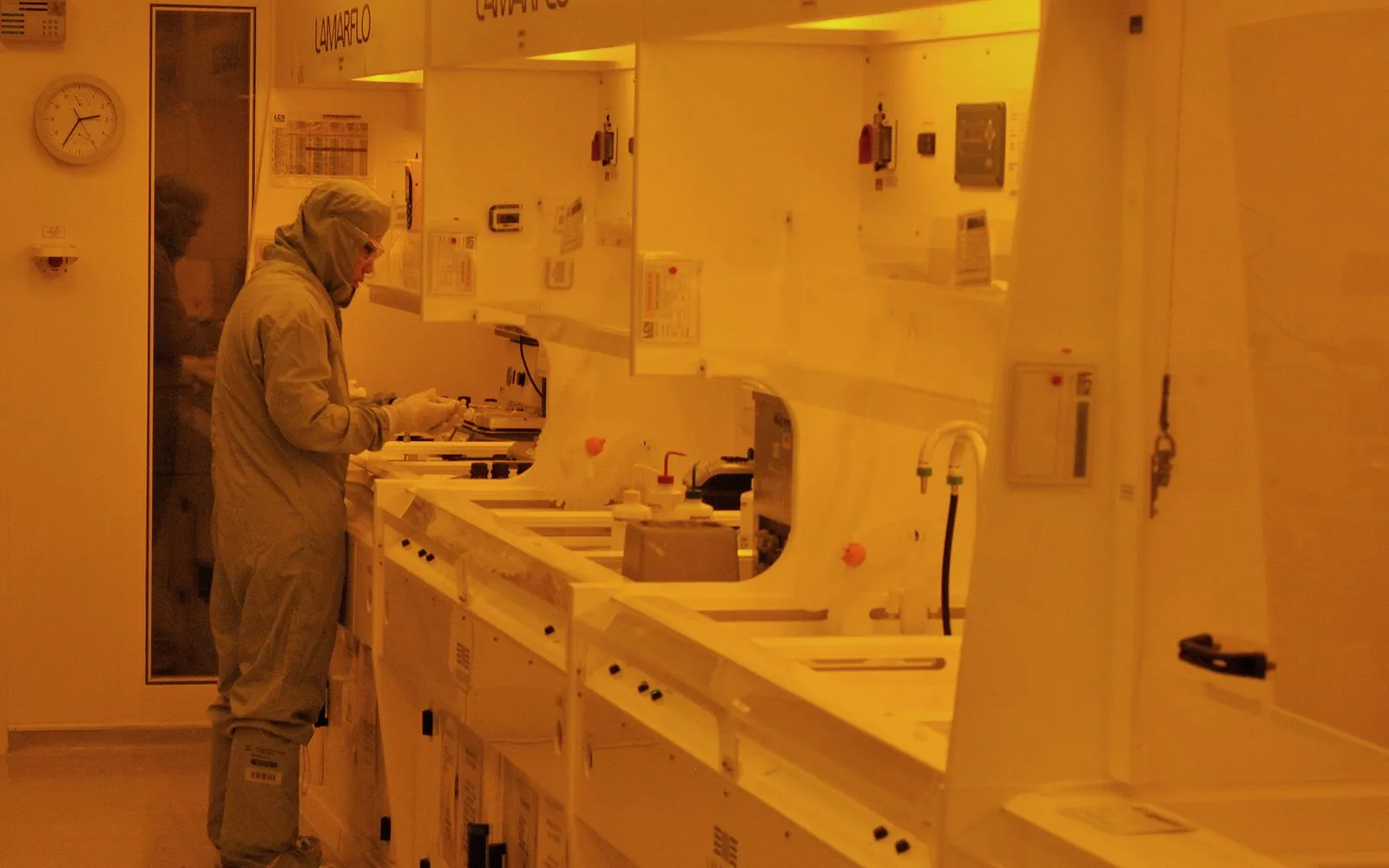
Cover photo: "Scientist in the LCN cleanroom photolithography lab" by O. Usher (UCL MAPS), CC BY 3.0, via Wikimedia Commons. Cropped from the original.
- Semiconductor Training
- Cleanroom Training
- VR Training Malaysia
- Vietnam Semiconductor
- Singapore Semiconductor
- XR Labs