Most people who try VR safety training remember it. They remember the moment the scaffold board gives way or the valve sprays when they open it out of sequence. What is less clear is whether a five-minute demo changes how a worker behaves on a Tuesday afternoon, three months later, when nobody is watching.
We build VR training labs for training centres, factories and vocational schools, and this is the question we get asked most. This article looks at the safety picture in Singapore and Malaysia, what the research says about VR training, and the technical choices that separate a programme that works from an expensive headset cupboard.
The safety picture in Singapore and Malaysia
Singapore is among the safest places in the world to work, and it is still not good enough for the people who run high-risk sites. According to the Ministry of Manpower's 2025 Workplace Safety and Health report, the fatal injury rate fell to a record low of 0.96 per 100,000 workers. There were 36 workplace deaths. Vehicular incidents, falls from height and the collapse or failure of structures and equipment accounted for 28 of them, and construction alone recorded 13.
Two details stand out. In construction, small-scale works made up more than 60 percent of fatal and major injuries. Those are short jobs with small crews, where formal training is thinnest. And while construction and manufacturing improved, the injury rate in transportation and storage rose from 18.4 to 23.8 per 100,000 workers.
Malaysia is at a different point on the curve. The Department of Statistics Malaysia recorded 38,950 occupational injuries in 2023, including 324 deaths, a fatality rate of 2.05 per 100,000 workers. Manufacturing had the most injury cases (10,335), while construction had the most deaths (88).
The legal ground has also shifted. The Occupational Safety and Health (Amendment) Act 2022 came into force on 1 June 2024. It extends the Act to all workplaces, requires employers to carry out risk assessments, requires an OSH coordinator at workplaces with five or more employees, and raises the maximum penalty for employers to RM500,000. For many Malaysian companies, "we did the briefing" is no longer a comfortable answer.
The wider Southeast Asian picture follows the same pattern. Fast-growing manufacturing, petrochemical, logistics and construction sectors employ a young, mobile and often multilingual workforce, and they need to train people quickly and consistently across several sites.
What the research says about VR safety training
The evidence is better than it was five years ago, with some caveats.
- A 2024 systematic review and meta-analysis in Safety Science (Scorgie and colleagues) covered 52 studies. It found that VR safety training outperforms traditional training for both knowledge acquisition and retention. It also found that only 36 percent of the studies measured long-term retention, so the field is still thin on what happens months later.
- A study by the University of Nottingham, funded by IOSH, compared VR with PowerPoint for fire safety and vehicle disassembly procedures. Straight after training, the PowerPoint group actually scored higher. One week later their scores had dropped much further than the VR group's. The VR group also reported more engagement and a better attitude towards safety.
- Singapore's WSH 2028 strategy names "strengthen WSH training through technology" as a key recommendation, and MOM's own guidance points to AR and VR for training staff to handle real-life situations without risking equipment.
Our reading of this is simple. VR helps most where the hazard cannot be safely rehearsed and where the order of steps matters. It helps least when it is used as a one-off experience. The value comes from repetition, scoring and a link back to real equipment.
Why so many VR safety programmes stall
We see the same three problems again and again:
- Content that is generic. A stock "work at height" module set on a generic construction site does not look like your plant. Workers notice, and the procedure in the module is rarely your procedure.
- No measurement. If the module only plays a scenario and shows a score at the end, the safety team cannot see which step people get wrong, so nothing improves.
- No path to the real job. Trainees practise in VR and then go straight to the site. The bridge between the virtual valve and the real one is missing.
Fixing these is mostly an engineering and instructional design problem, not a hardware one.
How a good VR safety module is built
This is the workflow we use when we build safety and maintenance content. It is more technical than most guides, because that is where projects succeed or fail.
- Start from your own procedure. We begin with the site's job safety analysis, SOP, permit-to-work steps and recent incident reports, not a script. Every step in the module maps to a line in a document the safety team already owns.
- Mark the critical controls. Each step is tagged as normal or critical. Isolating energy, checking gas readings before confined space entry, clipping on a lanyard: a critical error ends the attempt, the same way it would end a real job.
- Model the real equipment. Pumps, valves, panels and the room itself are rebuilt from photos, drawings and site visits at real-world scale. AI tools now speed this up a lot; we describe that process in our article on AI 3D modeling for VR.
- Show consequences, not just warnings. If a trainee opens a line before depressurising it, the module shows what happens. Seeing the consequence once teaches more than reading the warning ten times.
- Score every step. Each action is checked against the procedure, with time, order and errors recorded. A trainer can see that half the class misses step 14, which is usually a sign the real SOP or signage needs fixing too.
- Keep sessions short. Blocks of 10 to 20 minutes with teleport movement keep motion sickness low and fit into a shift.
- Pair it with the physical rig. Trainees learn the sequence and the safety points in VR, then repeat them on real equipment in the same room.
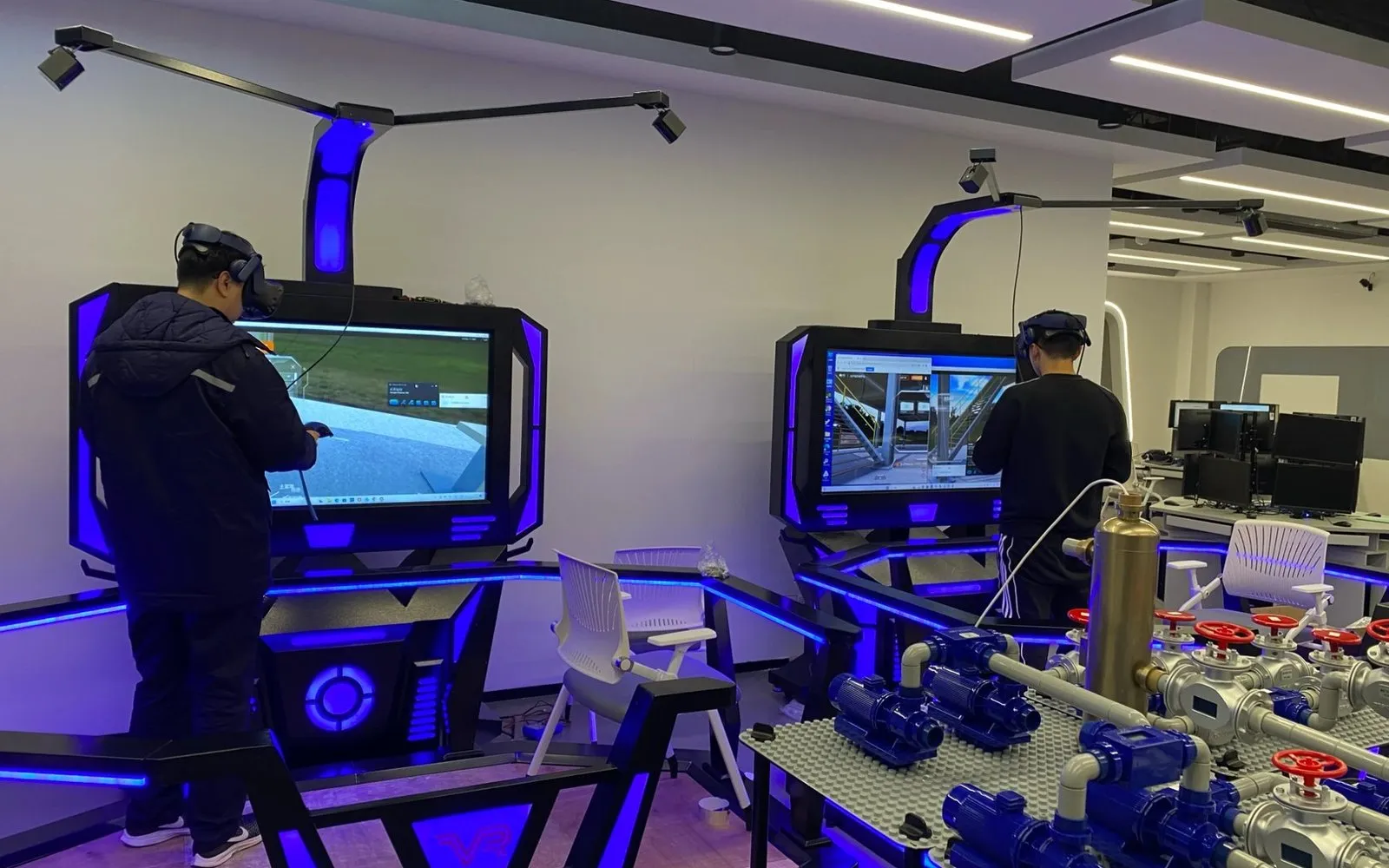
That last point is our signature. In the Chemical Equipment VR Training Lab we delivered, multi-user VR stations sit beside physical valve and piping rigs. The modules cover diaphragm metering pump maintenance and fractionation tower piping. Trainees walk from the headset to the real valve, and the trainer sees both. Another system we built takes staff through a 30-step valve assembly maintenance procedure, scored step by step.
Technical choices that matter
Headsets. Standalone headsets such as Quest 3 are easy to deploy and move between sites. PC VR stations give higher visual fidelity and suit fixed training rooms with heavier scenes. Many labs use both: PC VR in the training centre, standalone headsets for site refreshers.
Group formats. Not every safety lesson needs a headset. A CAVE or immersive projection room lets a supervisor walk a whole crew through a site at full scale, point out hazards and discuss them together, which works well for toolbox talks and emergency drills.
Platform. Our modules run on AeduVerse, a browser-based WebXR platform. It runs on PCs, mobile devices, VR headsets and CAVEs without installing software. Trainers can update steps, hotspots and questions themselves in AeduVerse Creator, so a change to a procedure does not wait for a developer. After a session, the trainer can see which steps each trainee completed and where they made mistakes.
Language. Singapore and Malaysian sites often have crews who speak four or five different languages. A procedure that is shown rather than told travels across languages better than a slide deck. Voice-over and labels can then be added for the languages your workforce actually speaks.
Data. The lab runs on your premises, and training records stay with you. This matters for companies whose procedures and plant layouts are confidential.
Where VR safety training fits in a compliance plan
VR does not replace accredited courses. In Singapore, WSH courses such as work-at-height or confined space training are delivered by accredited providers. In Malaysia, DOSH-recognised courses and certifications remain the formal route. VR works best around them:
- Before the course: trainees arrive already knowing the sequence and the hazards.
- Before the first real job: new hires rehearse the site's own procedure on a model of the site's own equipment.
- As a refresher: short, scored modules every few months, which addresses the retention gap the research points to.
- After an incident or near miss: the scenario is rebuilt and the whole team trains on it within weeks.
Funding is worth checking early. Singapore employers may be able to use SkillsFuture and Workforce Singapore schemes, and Malaysian employers often look at HRD Corp. Eligibility depends on the programme and the provider, so confirm the details with the agency before you plan your budget around it.
How Aedu AI helps
Aedu AI is a Singapore company that designs, installs and supports XR Labs: industrial VR training rooms, VR classrooms, CAVE immersive spaces and mixed reality spaces. For safety training we deliver the whole room: site survey, hardware, installation, safety modules built from your equipment and procedures on AeduVerse, trainer training and local support. We are based in Singapore and deliver labs for customers in other countries as well.
See the labs we have built on our projects page, read more about Aedu AI, or use Get in touch on any page to tell us which procedure you want to train first.
Key points
- Singapore's fatal injury rate reached a record low of 0.96 per 100,000 workers in 2025, but falls, vehicles and equipment failures still caused most deaths, and small-scale works carry most construction risk.
- Malaysia recorded 324 workplace deaths in 2023, and the OSH (Amendment) Act 2022, in force since 1 June 2024, raises the bar on risk assessment and training.
- Research shows VR safety training beats traditional methods on knowledge and retention, but long-term evidence is still limited, so repetition and measurement matter.
- Effective modules start from the site's own SOP, mark critical controls, score every step and pair VR practice with the physical rig.
- VR complements accredited WSH and DOSH training; it does not replace it.
FAQ
Is VR safety training recognised by MOM or DOSH?
VR is a delivery method, not a certification. Accredited WSH courses in Singapore and DOSH-recognised courses in Malaysia remain the formal route. VR is used to prepare trainees before those courses, to rehearse site-specific procedures, and for refreshers.
Which safety topics suit VR best?
Work at height, confined space entry, lockout and isolation, hot work, chemical handling, lifting operations and emergency response. These are high-risk, procedure-driven tasks that cannot be practised safely for real.
Can you build modules from our own equipment?
Yes. We rebuild your equipment and site at real scale from photos, drawings and site visits, and the steps follow your SOP and permit-to-work process.
Do we need a dedicated room?
Not always. A few standalone headsets can start a programme. A dedicated room with VR stations beside physical rigs gives the best results for maintenance and operations training, and a CAVE suits group briefings.
Do you work outside Singapore?
Yes. We are based in Singapore and also deliver labs for customers in other countries. Tell us where your site is and we will plan the survey, installation and support around it.
Sources
- Ministry of Manpower, "Workplace Safety and Health Report 2025" (25 March 2026): https://www.mom.gov.sg/newsroom/press-releases/2026/0325-wsh-report-2025
- Department of Statistics Malaysia, "National Occupational Injury and Disease Statistics 2023" (12 November 2024): https://www.dosm.gov.my/portal-main/release-content/big-data-analytics-national-occupational-injury-and-disease-statistics-
- Rajah & Tann Asia, "Key Changes to the Occupational Safety and Health Legislation in Malaysia": https://www.rajahtannasia.com/viewpoints/key-changes-to-the-occupational-safety-and-health-legislation-in-malaysia/
- Employment Hero, "Malaysia's Occupational Safety and Health (Amendment) Act explained": https://employmenthero.com/my/blog/occupational-safety-and-health-amendment-act/
- Scorgie et al., "Virtual reality for safety training: A systematic literature review and meta-analysis", Safety Science 171 (2024): https://mro.massey.ac.nz/handle/10179/71203
- University of Nottingham, "Virtual reality training could improve employee safety": https://nottingham.ac.uk/news/virtual-reality-training-employee-safety
- WSH 2028 Strategy Booklet, WSH Council: https://www.tal.sg/wshc/-/media/TAL/Wshc/About-Us/Files/WSH2028_Strategy_Booklet.pdf
- Ministry of Manpower, "WSH technology": https://www.mom.gov.sg/workplace-safety-and-health/wsh-technology
- VR Safety Training
- WSH Training Singapore
- OSHA Malaysia
- Industrial VR Training
- Southeast Asia
- XR Labs