For years, VR training in many organisations meant a demo corner: a headset, a showcase scenario, a few curious visitors. This week's news points somewhere else. Immersive training is being built into how companies and colleges prepare people for real operations, with scenarios tied to daily work and data on how each trainee performs.
What happened this week
SATS opened an Immersive Centre with Singapore Polytechnic. On 15 October, SATS launched an Immersive Centre at its airfreight terminal in Singapore, co-developed with Singapore Polytechnic and supported by a grant from the Civil Aviation Authority of Singapore. Senior Minister of State Sun Xueling opened it. The centre uses high-fidelity simulation to train aircraft turnaround coordination, airside safety procedures and cargo handling, for individuals and for teams. It also lets teams rehearse unusual and high-risk situations that are difficult to recreate safely on a live apron. Students preparing for aviation careers will train there too. Singapore Polytechnic describes the partnership as covering VR-based sessions for airside operations as well as advanced simulation projects.
LATAM Cargo scaled VR training in Miami. The same day, LATAM Cargo reported that it is rolling out VR training to about 550 warehouse employees at its Miami hub, including 250 forklift operators, after a first deployment in Santiago. The modules cover pedestrian zones in the warehouse, forklift operation, dangerous goods segregation and cargo handling. The system records how quickly each trainee identifies and responds to hazards, and the company is assessing other hubs, including Brazil.
Interplay Learning launched simulation-based skill verification. Also on 15 October, Interplay Learning introduced a tool that uses simulations of real equipment to check whether a trades worker can actually perform a task, not only whether they completed a course.
Three shifts behind the headlines
1. From showcase to operations. SATS built its centre inside an operating airfreight terminal, around the tasks its staff perform every day. LATAM Cargo moved from one warehouse to a major hub and is planning more. Immersive training is becoming part of the training plan, not a side project.
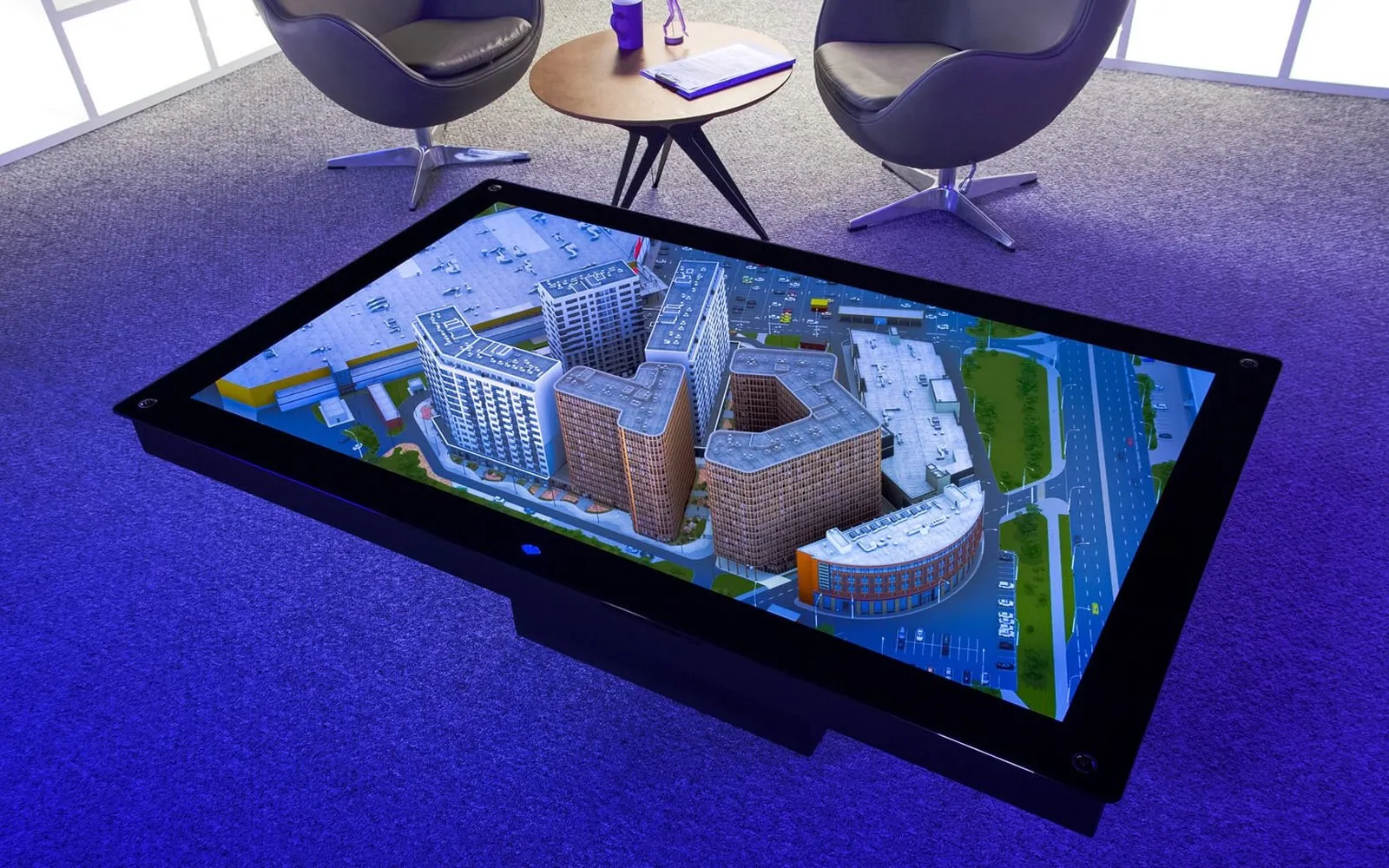
2. Team training and high-risk rehearsal. Aircraft turnaround and cargo handling are team activities. The biggest value of simulation is practising the situations you hope never happen, together, without risk to people, aircraft or cargo. This is where shared immersive spaces such as a CAVE, where a whole team sees the same scenario without headsets, complement individual VR stations. Before and after a drill, a hologram table lets the team review the 3D layout of an apron, warehouse or site together and agree on who does what.
3. Measuring performance, not attendance. LATAM Cargo records hazard response times. Interplay verifies skills in simulation. Training managers increasingly want evidence that a trainee can do the job safely, and simulation can produce that evidence in a way classroom slides cannot.
Choosing the right immersive format
Different training goals call for different rooms. Most XR training labs combine two or three of these:
- Industrial VR training room: individual VR stations, often placed beside real equipment or rigs, for operating procedures, maintenance and safety drills such as forklift, crane, chemical plant or airside tasks.
- CAVE immersive space: three to five projected walls with optical tracking, so a team or a class can stand inside a scenario together. Suited to team coordination, walkthroughs, design reviews and briefings.
- VR classroom: a whole class on headsets or PCs, led by one teacher console, for scheduled lessons and virtual simulation experiments.
- Mixed reality space: digital content placed over the real room, for design review and hands-on tasks where trainees must still see their surroundings.
- Holographic displays: a hologram table for small groups to review 3D models of a site, aircraft stand or production line during briefings, without headsets.
Content matters as much as hardware. Scenarios should be built from the organisation's own equipment, procedures and incident history, and teachers should be able to update them without writing code.
What this means for polytechnics, ITE and training centres
The SATS and Singapore Polytechnic partnership is a model many institutions in Singapore and Malaysia are moving towards: industry brings the real tasks, the institution brings teaching expertise, and an immersive training facility connects the two. For polytechnics, ITE colleges, TVET institutions and industrial training centres, a few practical points follow:
- Start from the tasks. List the procedures that are dangerous, expensive or rare to practise for real. Those are the first scenarios to build.
- Plan for both individuals and teams. VR stations for individual skills, a CAVE or projection space for team drills and group teaching.
- Decide what you will measure. Completion, time, errors and response to hazards, so results can feed into assessment.
- Keep content editable. Procedures change; the platform should let instructors adjust scenarios themselves.
Aedu AI designs, supplies and installs XR Labs in Singapore, Malaysia and across Southeast Asia: industrial VR training rooms, VR classrooms, CAVE systems and mixed reality spaces, with course content on AeduVerse, our browser-based XR training platform where teachers build lessons without code and teach a whole class in one shared space. For more on safety scenarios, see VR Safety Training in Singapore and Malaysia. If you are planning an immersive training room, .
Key points
- SATS opened an Immersive Centre on 15 October 2026, co-developed with Singapore Polytechnic and supported by CAAS, for airside safety, aircraft turnaround and cargo handling training.
- LATAM Cargo is rolling out VR training to about 550 warehouse staff in Miami, including 250 forklift operators, and records hazard response times.
- Interplay Learning launched simulation-based skill verification for trades workers.
- Immersive training is moving from demonstrations into daily operations, team rehearsal of high-risk scenarios and measurable assessment.
- Most XR training labs combine VR stations for individual skills with a CAVE or projection space for team training.
FAQ
What is an immersive training centre?
A facility where people practise real tasks in simulated environments, using VR headsets, projected CAVE walls or mixed reality, so they can rehearse procedures and high-risk situations safely before doing them for real.
Is VR training effective for industrial and logistics safety?
It is increasingly used for tasks that are dangerous or costly to practise live, such as forklift operation, airside procedures and dangerous goods handling. Its main advantages are safe repetition, consistent scenarios and data on how each trainee performs.
What is the difference between a VR training room and a CAVE?
A VR training room gives each trainee a headset or station for individual practice. A CAVE projects the scenario onto the walls around a group, so a team can train together and still see each other, without wearing headsets.
Can polytechnics and ITE use VR for assessment, not only teaching?
Yes. Simulations can record completion, time, errors and hazard response, which instructors can use alongside practical assessments.
Who builds VR training rooms and CAVE systems in Singapore?
Aedu AI, based in Singapore, designs, supplies and installs XR Labs, including industrial VR training rooms, VR classrooms, CAVE systems and mixed reality spaces, for polytechnics, ITE, universities, TVET institutions and industrial training centres in Singapore, Malaysia and Southeast Asia.
Sources
- SATS, "SATS launches Immersive Centre to advance aviation safety and workforce readiness" (15 October 2026)
- Payload Asia, "SATS launches Immersive Centre to advance aviation safety and workforce readiness" (16 October 2026)
- Air Cargo News, "LATAM Cargo embraces VR for warehouse staff training" (15 October 2026)
- PR Newswire, "Interplay Learning Launches Skill Verification to Demonstrate Workforce Readiness" (15 October 2026)
- Cover image: ILLUMETRY EOS hologram table (product image: ILLUMETRY), supplied in Singapore by Aedu AI. It is not a photo of the SATS Immersive Centre.
- XR Labs
- VR Training
- Immersive Training
- CAVE
- Simulation Training
- Singapore